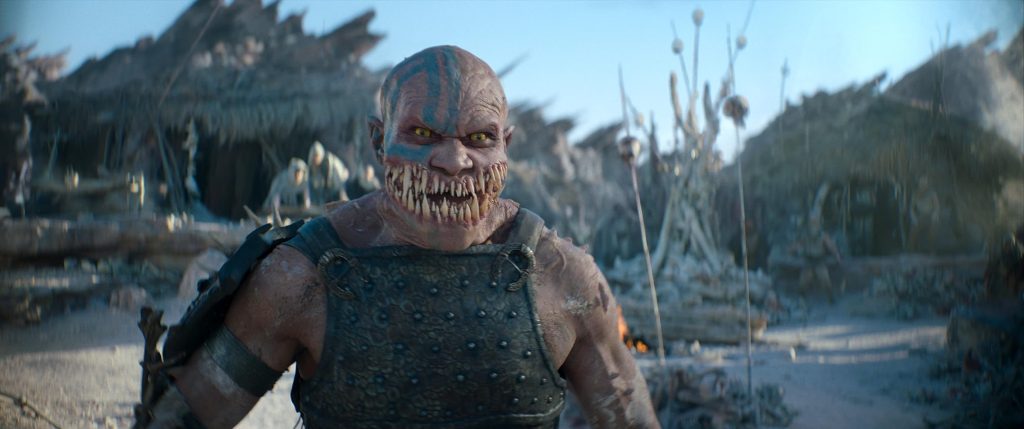
Just as I was starting to believe that the vampire movie genre was bankrupt of originality, I am gifted with a film unlike any other vampire film I’ve ever seen. Don’t you just love when that happens? I’m not going to pretend that I didn’t have reservations about this movie going in, especially with it being a sequel to The Hamiltons, a film I had not seen nor heard of before this film made it onto my docket. However all of my reservations subsided within fifteen minutes of pressing the play button. With a title like “The Thompsons” I was expecting it to be nothing more than vamp ripoff of Rob Zombie’s The Devil’s Rejects, but this film has heart along with the appropriate amount of blood and gore to keep it from becoming too sappy.

 Narrated by Francis Hamilton, the middle child in a family of five, he along with his siblings David, Wendell, Darlene, and Lenny travel a lot. After death of their parents, the family became restless and for years have been on an endless journey to find a permanent place to call home. A place they can be their true selves, a place where they don’t have to hide their “disease” as Francis calls it. The entire family was born vampires, and as vampires they must consume blood to survive. As a result of their affliction, they are unable to settle in one place too long because it would only be a matter of time before they were discovered, hence their constant moving.

What do you do when you have to choose between the law and what is morally right? Lieutenant Danny Sefton (Seth Gabel, TV’s Dirty Sexy Money and Fringe) faces that very problem in Allegiance. Having lost the respect of the men in his command by transferring to a recruiting position right before they are to deploy to Iraq, Sefton faces a crisis of conscience when one of those men — Specialist Chris Reyes (Shad “Bow Wow” Moss, Like Mike, Roll Bounce) — has his non-deployment waiver revoked.

Reyes’ son is sick. However, due to conflicting diagnoses — one says Stage 4 lung cancer; the other chronic asthma — and the fact that he’s the best medic in the company (and they don’t have a replacement), Lieutenant Colonel Owens (Aidan Quinn, Jonah Hex, TV’s Elementary) decides to deploy Reyes. Having exhausted all his options, Reyes tells Sefton he intends to go AWOL and asks for Sefton’s help.

Probably most known for his roasts on Comedy Central, Anthony Jeselnik offers an hour (included the many long pauses) of stand-up comedy that is 100% bad taste. Dark humour and a huge ego are Jeselnik's shtick so you have absolutely every reason to walk away from this...except you might actually catching yourself laughing.

Jeselnik never attempts to make friends with the audience. It's common for a comedian to talk to members of the crowd and perhaps take a few shots at them. Jeselnik sets out to offend and elevate himself above everyone in the room with him. Again...this is his act. Could he be a true egomaniac? Perhaps. He's certainly good at portraying one onstage. More importantly, is it funny? The answer: sometimes.

“I want to talk to you about the war for the soul of Los Angeles.”

This could easily describe the current rivalry between the surging L.A. Clippers and the geriatric Los Angeles Lakers, but Gangster Squad has slightly weightier matters on its mind. The stylish 1940s and 50s cops and crooks saga wants to tell a story about corruption and violent men unable — or unwilling — to turn off their capacity for hurting others. Instead, the film winds up being a somewhat shallow 21st century gloss on The Untouchables. And there’s absolutely nothing wrong with that.

If it were possible to buy stock in any under-25 actress today, I’d pick Jennifer Lawrence first, Emma Stone would be a close second, and Kristen Stewart would be last. Lawrence has a pair of blockbuster movie franchises in her back pocket (The Hunger Games, X-Men) and is already a two-time Oscar nominee, thanks to her recent nod for Silver Linings Playbook. So if a studio were to have a Jennifer Lawrence film on its bench, September 2012 would probably look like some prime real estate.

Prime real estate and a murder-related discount are what attract Elissa (Lawrence) and her mom (Elisabeth Shue) to their new home in House at the End of the Street. Elissa becomes drawn to reclusive next door neighbor Ryan (Max Thieriot). Four years earlier, Ryan’s parents were murdered by his sister, who promptly disappeared. (That explains how Elissa and her mom got such a good price on their rental.) Ryan now lives in the house by himself, but a series of strange occurrences make it clear Ryan’s house hasn’t seen its last dead body.

“Our enemy here is Al-Qaeda. It’s no secret they are not afraid to die. Neither are we. Tonight we know why we are here. We know who we are. Tonight we fight for something truly greater than ourselves. Tonight we ride.”

“It’s a good day to be a SEAL, good day to be an American.” Yes, I am aware that I’ve already opened with a film quote, but truthfully this film has quite a few good ones. Seal Team Six is the telling of Operation Geronimo, the successful mission that lead to the assassination of Al-Qaeda leader and engineer of the September 11th attack, Osama Bin Laden. I’m sure there are many that are thinking “why would a made-for-television film be made when on January 11, Zero Dark Thirty will premiere worldwide?” They may view the making of this film as a waste of money. They would be absolutely wrong.

If you were to print out all the quotes from the interviews in Method to the Madness of Jerry Lewis, a 116-minute documentary, you would swear that Lewis himself wrote them all. Steven Spielberg, Quentin Tarantino, Jerry Seinfeld, Eddie Murphy, Carol Burnett, Billy Crystal, Chevy Chase, John Landis, Carl Reiner, Richard Lewis (no relation) and Alec Baldwin are all so effusive in their compliments as to almost defy belief. Woody Harrelson says if you don't like Jerry Lewis, he doesn't even want to hang out with you. Comedian/Actor Richard Belzer (Law and Order) shows off his Jerry Lewis tattoo. Jerry Seinfeld says that if you don't laugh at Jerry Lewis, you don't understand comedy. Everyone interviewed in this film is completely unreserved in their love and respect for the man.

The film is a fairly comprehensive, looking at the 80-year career of the 85-year-old hyphenate (he is comedian/director/writer/actor/singer). Director Gregg Barson was given pretty much a free hand to record Jerry Lewis, the man behind the scenes in his daily life and activities. What comes out is a fairly vibrant and fresh perspective on the legend and icon. I was personally surprised how intelligent and sharp he still is. From news reports in recent years, it was easy to get the impression that he was a doddering and delusional old nut job. One omission from the documentary is any mention of Lewis's involvement in the Muscular Dystrophy Association which he singlehandedly turned into the most prominent charity in the world over many generations. It seems recently he has become disenchanted with the management, but it is not clarified here. What is brought into perspective is the truly monumental success of the man's life and career. It is hard to estimate the money he has made, but it must be astounding. At one point during a comedy tour he had a little time to churn out a movie. He made The Bellboy for a little under 1 million dollars with no studio help and has personally pocketed over 300 million dollars from that film alone. For many years, Paramount Pictures wouldn't have known what to do if they didn't get two Jerry pictures a year, he was that important to their bottom line.

If you watched any comedic movie in the late '90s, you’ve seen Harland Williams. A funny guy who always played the dummy (see Half Baked and Down Periscope), his career never took off the way similar stand-up comics like Jim Carrey and Norm MacDonald did. In this special, Harland performs his trademark wry and goofy comedy in a new, innovative way: the comedian does his routine outside and with no audience.

It’s just him and a microphone on top of a mesa in the Mojave Desert. Harland doesn’t mind breaking the fourth wall, telling the viewer at the start that it’s okay there’s no audience; that he believes you are smart and “I think you’ll know when to laugh.” Just in case we miss something, though, he throws sunflower seeds at us if he feels something was particularly funny, like his polio walk. (“C’mon, polio doesn’t even exist any more!”) This breaking of the fourth wall makes you feel like you’re there on the mesa with him.

If you’re any sort of discerning cinephile — and if you’ve taken the time to visit our fine site, I’m going to assume you are — you’ve probably heard of The Jazz Singer. Of course, for the movie-going public in the late 1920s, The Jazz Singer was unlike anything they’d ever heard: the first feature-length motion picture with synchronized dialogue. Or, put more simply, the first “talkie.” Though you probably know it revolutionized the film industry, I’m betting it’s a lot less likely you’ve actually seen The Jazz Singer.

I liken it to Jackie Robinson’s place in sports history. Most of us know Robinson was the first African-American Major League baseball player in the modern era, but I suspect a much smaller number of us have seen footage of Robinson in action. Similarly, The Jazz Singer’s place in film history has been secure for decades, but even movie nerds with more than 700 titles in their collections (hi there) haven’t gotten around to watching it. Fortunately, Warner Bros. has released a spiffy new Blu-ray of the groundbreaking 1927 film to help remedy this situation.

We catch up with iconic film director Tim Burton to find out more…

Frankenweenie is described as a semi-autobiographical project. Does this mean the younger characters in the movie are based on your classmates from school?