



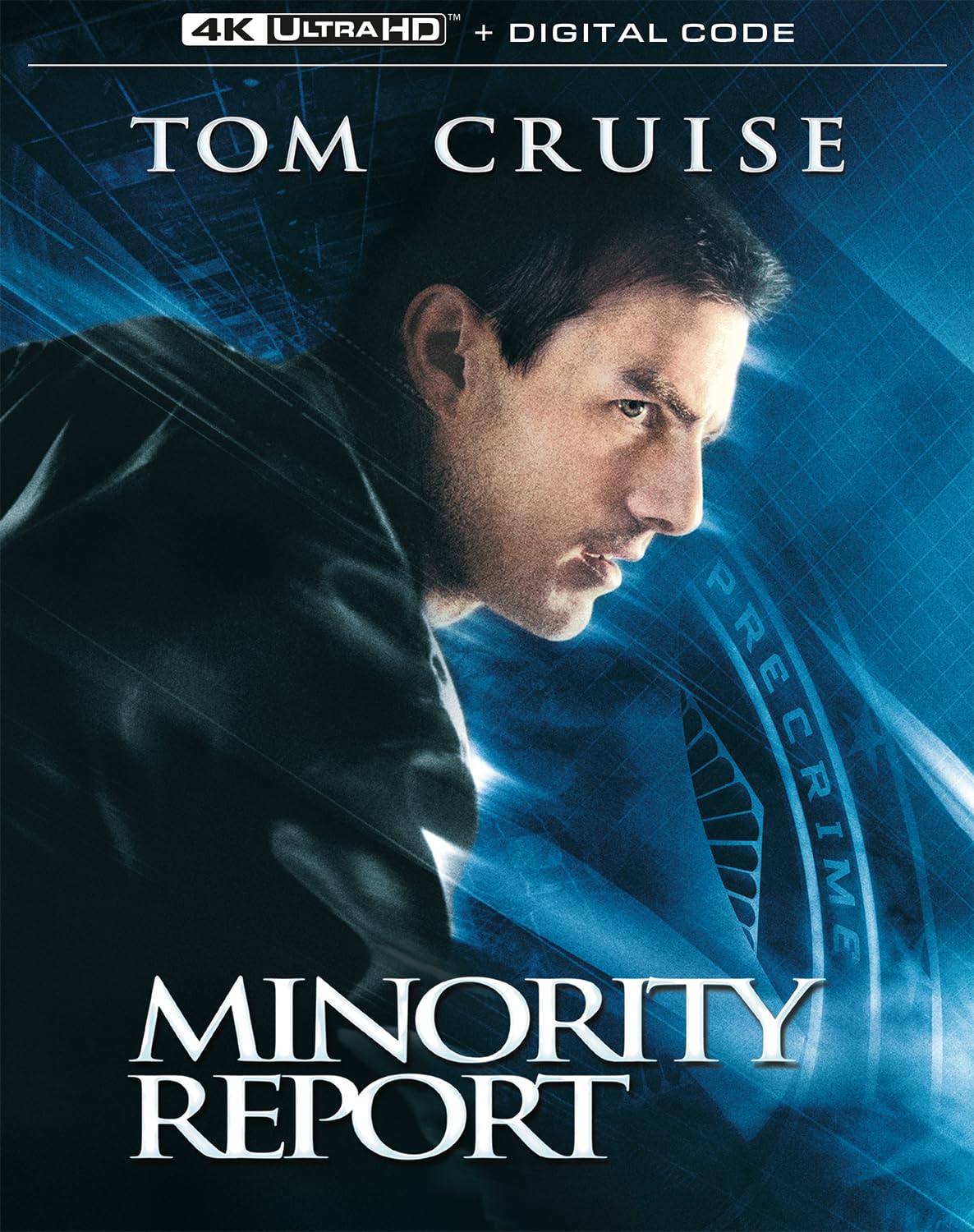

“Imagine a world without murder. Six years ago, the homicidal rates had reached epidemic proportions. It seemed that only a miracle could stop the bloodshed, but instead of one miracle, we were given three, the precognitive. Within three months of the precrime program, the homicidal rates in the District of Columbia had reduced 90 percent. Six years in the precrime program, and there hasn’t been a single murder. Now, the system can work for you. We want to make sure that this great system that will keep us safe will also keep us free. On April 24, vote yes on the national precrime initiative.”
From the mind of Philip K. Dick, there was a rush of box office gold that lasted several years. From his Do Androids Dream Of Electric Sheep came Bladerunner. From We Can Remember It For You Wholesale came Total Recall … twice. After the first Total Recall, there were plans of using Dick’s The Minority Report as a sequel. The stories are unrelated, but there was a script prepared, but somewhere along the way the film got tabled and sat unproduced for decades. It wasn’t until both Steven Spielberg and Tom Cruise took an interest in the project that the script was dusted off and taken for a spin. But there had been too much time since Total Recall, so screenwriters Scott Frank and Jon Cohen decided to return to the source material and create the standalone movie that would become Minority Report. It was the first time one of Dick’s stories would make it to the screen with at least a version of the story’s actual title. These guys just added the requisite “The”, and the story was now ready for prime time.
Tom Cruise plays pre-cog police officer Chief John Anderton. They work from an elaborate system centered around three individuals who have demonstrated precognitive abilities. The three spend their entire life floating in a pool of primordial-like goo and are networked to a complicated computer system that records their visions and alerts the officers in charge. You see, they know when a murder is going to happen, sometimes days before it actually happens. Of course, their visions are a bit muddy, so there is still need for investigation officers like Anderton. They take these muddled collections of images, and their job is to track down the killer and victim before the crime ever happens. This is a society where you are arrested and placed in a zombie storage state for a crime you never actually got around to committing. The film makes this process a lot more complicated than it needs to be, but let’s be honest here. It would be a little dull without the wooden balls that are laser-sculpted from a block of wood and engraved with the names of the murderer-to-be and the victim. There has to be a spectacle here, and so you have it. The precogs are named after classic mystery writers. The single woman, and the key to the whole program, is named Agatha after Agatha Christie. Dashiell after Dashiell Hammet, and Arthur after Sherlock Holmes’ creator, Sir Arthur Conan Doyle.
The program is only in use around the Washington D.C. area at this time. But there is about to be a voters’ initiative to take it all national. There are people who have a lot to gain if that happens. Enter Director Lamar Burgess, played by the talented Max von Sydow. He’s hiding a few secrets, and the national vote is somewhat of a huge power play for him. But there are some glitches in the system, and when Anderton starts asking the wrong questions, his name pops up on one of those wooden balls, and he has to go on the run. He has his own little secrets. His son was killed, and it’s one of the reasons he does this job. He’s also on a few unauthorized medicines.
For a large part of the film Anderton is being chased by his own team, and it leaves some awkward moments. He doesn’t want to hurt his guys, but he needs to be free to figure it all out. The mystery is actually quite a nice one with a lot of layered pieces, and it’s actually quite a fun ride as we hang out with Tom Cruise as he puts it all together. Spielberg does a really nice job of allowing us to sample this future world through Anderton’s flight, and there are some nice emotional beats that give the film a bit more than the previous films based on Dick’s works. Cruise does a great job of taking us not only on a thrilling ride, but an emotional one as well.
There are some nice supporting cast members here, but Cruise and Sydow do most of the heavy lifting. Samantha Morton has one of the hardest jobs bringing Agatha to life. We get to witness her in various stages of mental stability, and she gives us a sympathetic character here. I really love Neal McDonough, and this early role leaves him terribly underused. Steve Harris is known to most of us as Eugene from The Practice, but he’s pretty solid here, and there’s Colin Farrell in a very early part for him as an investigator who takes charge of hunting down Cruise. It’s a nice cast.
The f/x are a bit dated, and that comes through even with more force in 4K, but there are still some nice moments here, and while we don’t get quite the world-building that Ridley Scott gave us in Bladerunner, it doesn’t distract from the action even by today’s standards.
Video
Minority Report is presented in its original aspect ratio of 2.39:1. The ultra-high-definition 2160p image is arrived at by an HEVC codec with an average bitrate of 65 mbps. The ultra-high-definition image presentation does appear a bit glossy and at times unfocused. There’s a blurring going on here that might just be something connected to the f/x, because it’s not so obvious when we’re not out in the future world. Most of the time this isn’t the case. There’s a great amount of detail here that captures elements of the native 4K 35mm film here. Close-ups provide some of the best detail and texture. I’m also very pleased that the grain elements were not digitally destroyed as too often happens. I think Spielberg gives a little more attention to details on these releases, and the film grain appears to be retained with no real evidence of DNR washing. The HDR isn’t going to really pop with color. This film doesn’t really have a bright or vivid color pattern to it. There’s nice separation between the present world and those of the visions. Black levels come through, and it’s the nice contrast that stands out here.
Audio
The DTS-HD Master Audio 5.1 track is exactly the same as from the Blu-ray. It serves dialog and John Williams’ score, but it doesn’t have a lot of bottom to it, and it doesn’t quite match the depth of the image presentation.
Special Features
The extras are all on the Blu-ray and are ported over from the earlier release. Nothing new to see here.
Final Thoughts:
Paramount gave us a one-two punch of Spielberg’s two 2002 films. Catch Me If You Can was the other film, and it was a bit more disappointing on the image side of things. That’s not the case here, and I’m glad there was more effort given to this one. Both films are worthy of your 4K upgrade, and if you’re fans of the films, these will add to your library nicely. If you’re not fans, now’s the time to take a look at two Steven Spielberg gems from 20 years ago. Spielberg doesn’t just present you with a viewing experience. “He’s inviting you to go with him.”
