2:39:1 Widescreen

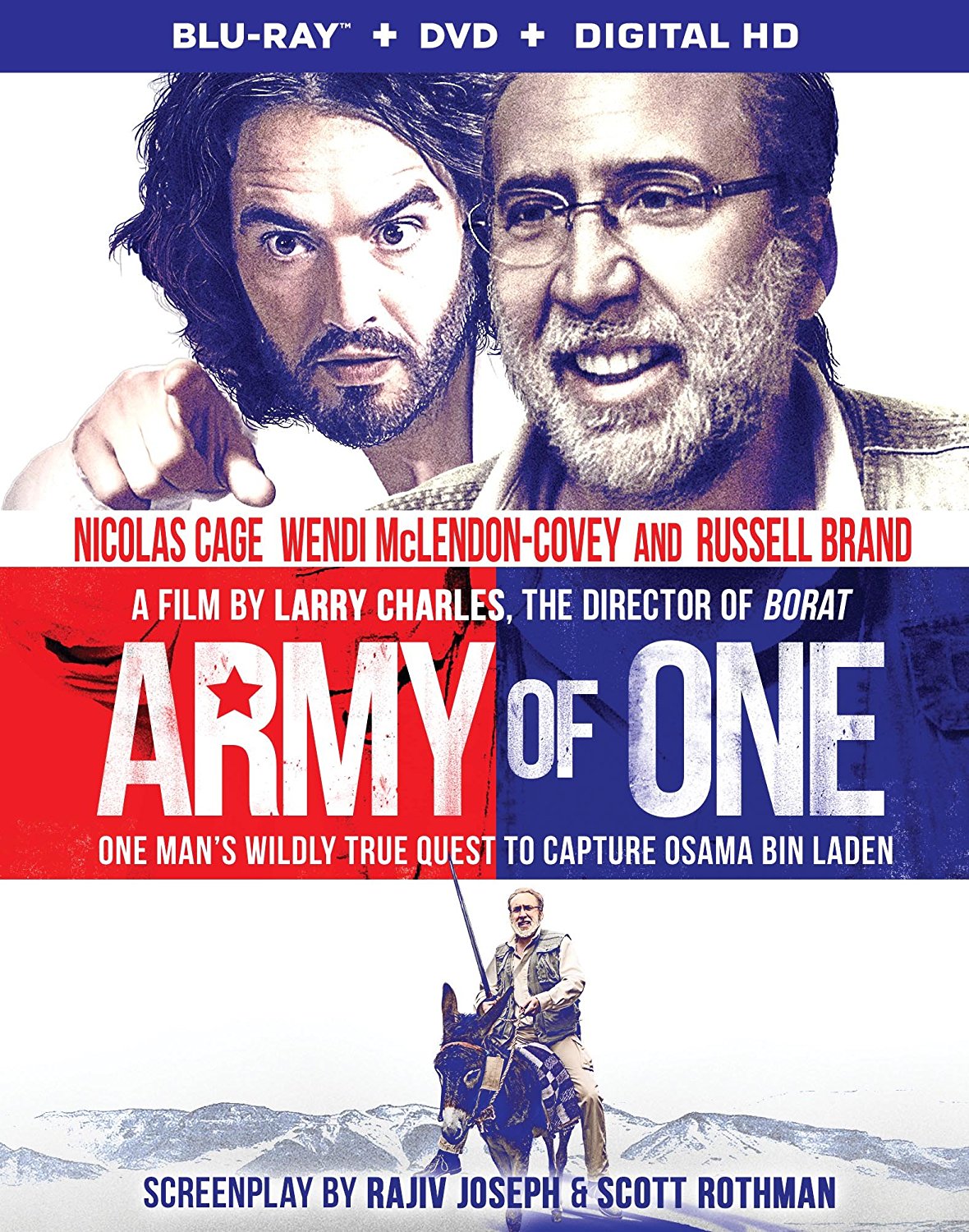
It’s been a while since Nicolas Cage has been in a big studio-released film.  It doesn’t mean he’s doing bad movies; it just means he’s not doing any tent-pole releases that flood the multiplex.  Seeing Nicolas Cage in a film like Army of One is simply a snapshot of how modern cinema has to evolve for better or for worse.  Really, I don’t mean to come off as though this is a bad film or inferior to any other films past or present, but ten years ago this is a film that would have had a much wider release and would easily have gotten more attention.  After all, who could resist Nicolas Cage in a film helmed by the director of Borat?

I vaguely remember hearing the story in the news. American Gary Faulkner (Cage) decides to set off on his own to capture Osama Bin Laden and bring him back to the US.  It was a story that was a little more than a blip in the headlines, but thankfully we have Army of One that delivers a film that embraces the insanity of the scenario and takes some liberties with the true story, all in the name of comedy.

"Space... The final frontier. These are the voyages of the Starship Enterprise. Its continuing mission, to explore strange new worlds. To seek out new life and new civilizations. To boldly go where no one has gone before."

Every Star Trek fan knows the words by heart. For 50 years they've heralded the promise of something special. From the television show that couldn't but did anyway to 12 feature films. Would #13 be the lucky one? The trailers left many of us worried that it would more than likely be unlucky. And we needed so much for this one to be great. Since the last film we lost Leonard Nimoy, who was most certainly the heart of the franchise on the screen. He was also the gateway between the two incarnations. That loss was eventually expected. Then we tragically lost Anton Yelchin, who was one of the industry’s rising stars. It's the 50th anniversary, and with all this we really needed something good. Trailers said we were out of luck. They say you shouldn't judge a book by its cover. I'm here to tell you that you can't judge a film by its trailers. Star Trek Beyond turns out to be not only what the fans wanted... but what we desperately needed.

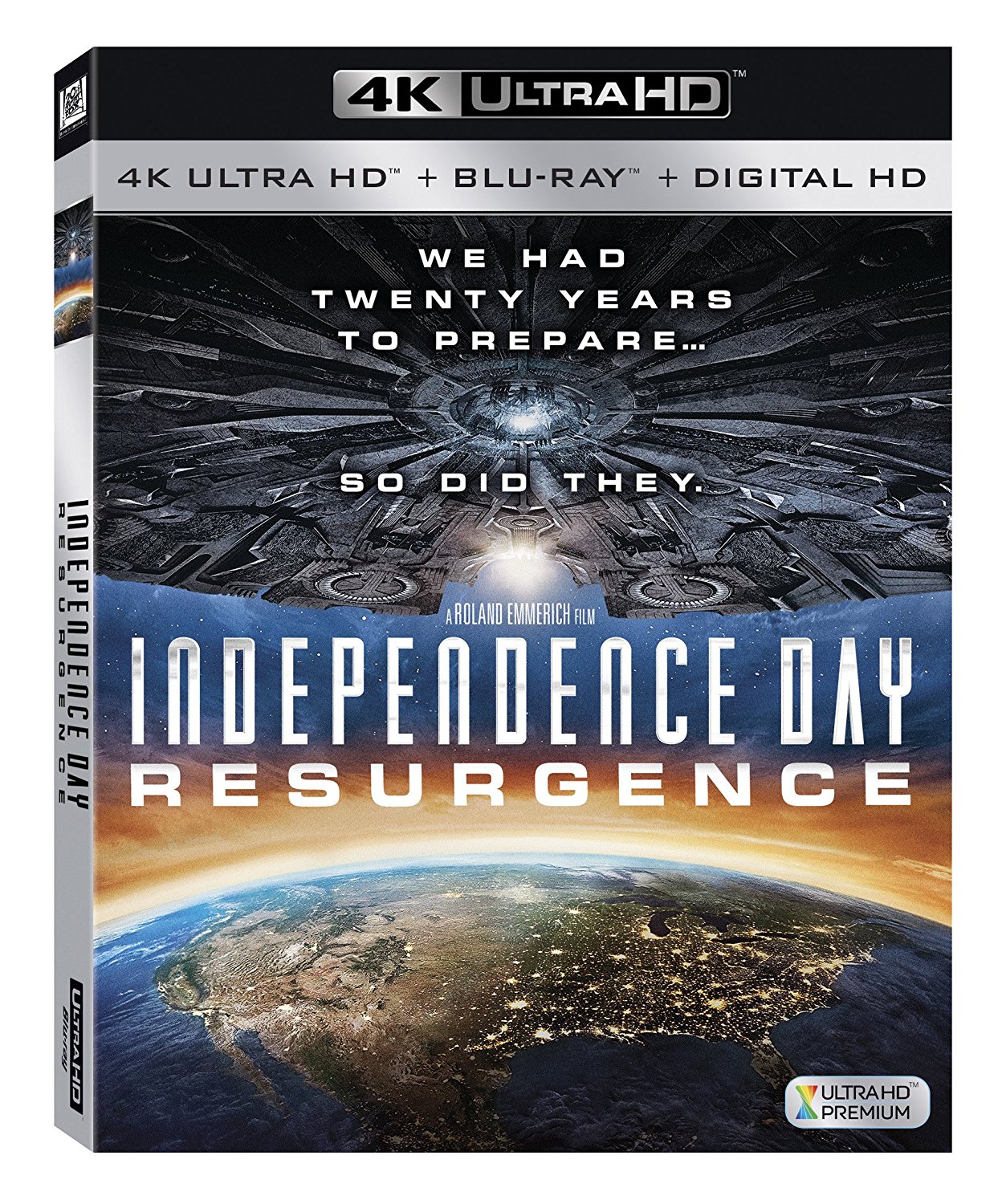
“The countless lives we lost in the War Of '96 did not perish in vain. They inspire us to rise from the ashes as one people of one world. For 20 years the world has seen no armed conflict. Nations have put their petty differences aside. United, we rebuilt our families, our cities and our lives. The fusion of human and alien technology not only enabled us to defy gravity and travel at unimaginable speeds. It also made our planet finally safe again."

Not so fast there, cowboy. There would be no need for a sequel to the 1996 hit film Independence Day if the big bad aliens weren't coming back. Unfortunately, the aliens made the same mistake that Dean Devlin and Roland Emerich made with the film's sequel. They both waited too long.

I can’t be the only one who misses seeing Mel Gibson in a tent pole movie for the studio every year.  Sure, he said some rotten things, but does it matter what he does in his personal life?  The man still is a great actor and an even better director.  Hollywood has always been forgiving of its talent; it’s a system that seems to enjoy seeing talent make a comeback and do some amazing work.  What it seems is that sometimes we forget that these icons on the screen are human, and they make mistakes and do stupid things and they have to own these experiences for the rest of their lives in the spotlight.  I bring this up simply because when you look back at Mel Gibson and his downfall, Blood Father seems in many ways a reflection of the past decade for Gibson, minus the body count, of course. Rather than just roll over and phone in some roles like many of his contemporaries have, Gibson has been finding roles that continue to remind me why audiences connected so much to his work.

John Link (Gibson) is an ex-con and also a recovering alcoholic who struggles every day to make up for his past mistakes.  He’s lost his wife and hasn’t seen his kid in years; he manages to get by running a tattoo shop out of the trailer he also lives in.  He’s living on hard times but owns up to his mistakes and is working towards the day he can be forgiven for those mistakes.  His sponsor, Kirby (William H. Macy), is pretty much his only friend and does what he can to keep John on the right path, but things get more than a little complicated when John hears from his daughter, and she is asking for help.

"Never underestimate the impact of dramatic entrance!"

It's hard to maintain the attention of the 21st-century child. Animated movies have to combine enough elements of charm and action to keep their attention for a little under two hours. If you want to keep a franchise going, you have to rip out your sequels in reasonably tight schedules. It's been over four years since Kung Fu Panda 2, and we waited nearly that long between the first and second entry. That's a long time in a culture where we move from fad to fad almost by the hour. But if the films are good enough and leave enough of an impact, you might be able to bridge those years successfully. In 3-4 years you're almost targeting a new generation of your target audience. Kung Fu Panda 3 appears to have found the secret of that kind of franchise longevity.

“Hello boys…I’m baaaaaack!”

You probably know that Independence Day — the spectacular, shameless sci-fi smash that introduced the world to “Will Smith, Global Superstar” — dropped a sequel last month. What you may not know is that the original film has been granted a 20th Anniversary Blu-ray and UHD release. I was 13 when ID4 came out in the summer of 1996, which means the movie’s deluxe destruction and alien shoot-em-up antics were right in my wheelhouse. So I was curious as to how an older and wiser, um, taller version of me would feel watching it with a critical eye.

We’ve all heard and seen the story before; a family loses a loved one and consumed with grief they meddle with unknown forces to see their loved ones again.  The Monkey’s Paw is one of my favorite stories that cover the topic. I’m sure everyone at some point had to read this short story in school.  Having read the story and seen the numerous films that have covered the topic, you’d think by now people would have learned to not mess with forces they don’t understand.  The Other Side of the Door is the new paranormal horror film to cover the subject, and it seems people still just haven’t learned. Is the film worth taking a look to see what lies beyond the door, or is this one better left alone?

After taking a trip to India, Maria (Sarah Wayne Callies) and Michael (Jeremy Sisto) love the country so much that they decide to move and raise a family there.  The family seems to be doing well; they eventually have a son, Oliver (Logan Creran) and a daughter Lucy (Sofia Rosinsky).  Everything seems to be great till there is a tragic car accident where Maria is faced with losing Oliver after being unable to free him from the car as it becomes submerged in a river.  Of course grief and guilt overwhelm her, and with good intentions a maid at their home refers Maria to a temple where she can perform a ritual and say a proper goodbye to her son.  Only there is a rule: don’t open the door no matter what you hear.  Well, we wouldn’t have much of a movie if she’d followed the rules. Besides, in these films the characters do nothing but make terrible decisions while we look on from the comfort of our seat shaking our heads about their foolish choices.

Disaster films are something that for me screams American cinema of the 90’s.  I know there were films before that had come out, but a good portion of my teen years of the 90’s were of the mega-blockbuster variety like Twister, Dante’s Peak, The Perfect Storm, and so forth.  Now we have The Wave, the first disaster film to come out of Norway, and from the looks of the trailers they were going for something BIG.  This is a film that comes out with so much potential and is a film that could even possibly find an American audience that could look past the fact that subtitles may be involved.  With the way technology has come along over the years, smaller countries have been able to produce films as big as anything released in our cinemas here in the states.  Now here’s the question: is it any good, though?

Welcome to the small mountain town of Geiranger, Norway.  It’s a quaint little town that attracts tourists with its isolation and beautiful landscape.  But having this little slice of vacation paradise comes at a price.  Geiranger sits in an area that has a lot of activity with the rocks moving beneath the surface, this movement geologists believe will one day cause a collapse of a mountain spilling into the fjord below which will create a massive Tsunami. Basically Geiranger is a town simply waiting to be wiped out by this massive wave.  This is where we meet Kristian (Kristoffer Joner), a geologist that has been studying Geiranger for years but is now moving away to the city for a “better job”.  It comes as no surprise that as he and his family are packing and ready to move that Kristian is troubled by recent recordings from around the area and has a feeling something bad is going to happen.  (One thing I’ve learned from disaster films, always listen to the nut job that believes the end is coming.)

Bad Robot, in my eyes, is simply the best at keeping things a secret.  In this day and age, to be able to surprise audiences is just about an impossible task.  When the first Cloverfield trailer was released in 2007 in front of Transformers, it was a trailer that had us all guessing up until its release.  In my opinion Cloverfield was one of the best found-footage films to come out and was a grand achievement, considering it was a monster film that had been pretty much been kept under wraps until its actual release.  Bad Robot managed to surprise us again, releasing a trailer for 10 Cloverfield Lane that set the internet on fire with theories and hopes for this to be a long-awaited sequel.  But is that what this really is?

What I want to go ahead and get out of the way is, if you’re hoping for spoilers, there will be none, other than to say if you are expecting a big-budget extravaganza filled with monsters destroying cities, this is not that film.  Don’t waste your money on the big IMAX presentation, because you will feel cheated.  Instead, what 10 Cloverfield Lane delivers is something more intimate than I would have expected, and it takes the thriller genre back to its basics.

There are many films that depict the ferocity and cataclysmic power of the vast ocean. It is a fearsome display that cannot be imagined in any way that compares to the reality of the experience. The Perfect Storm, Life of Pi, The Guardian, and Titanic are just a few examples of disasters at sea. It is the United States Coast Guard’s job to rescue distressed people under severe emergencies at sea. The Finest Hours is a depiction of a true-life sea rescue under the most challenging and horrifying conditions. It is known as the most successful small boat rescue ever recorded. When I say small boat, it is the rescue boat I’m talking about, but the ship they were singlehandedly sent to rescue was a gigantic T2 tanker Pendleton, which had split in half on open seas. Part of the problem was that another tanker had already split in half a few hundred miles away, and all resources had already been diverted in that direction. The second tanker was an afterthought that was tackled by a relatively inexperienced crew. To repeat the true-life situation, T2 tankers SS Mercer and SS Pendleton were split in half off the New England coast. The Pendleton had lost radio communication and was only identified by an alert citizen from the shore.

The Finest Hours is a Walt Disney film, and I think Walt would be proud. The film takes place on February 18, 1952, and all of the American values that were part of this country at the time are on display. It is a very old-fashioned film in both look and approach. The only difference is that modern-day technologies are fully utilized to show an amazing true-life display of courage that would have been impossible to do in 1952.