Studio

"Well, you think about it, Ethan, it was inevitable. No more cold war. No more secrets you keep from yourself. Answer to no one but yourself. Then, you wake up one morning and find out the President is running the country without your permission. The son of a bitch, how dare he. Then you realize, it's over. You are an obsolete piece of hardware, not worth upgrading, you got a lousy marriage, and 62 grand a year."

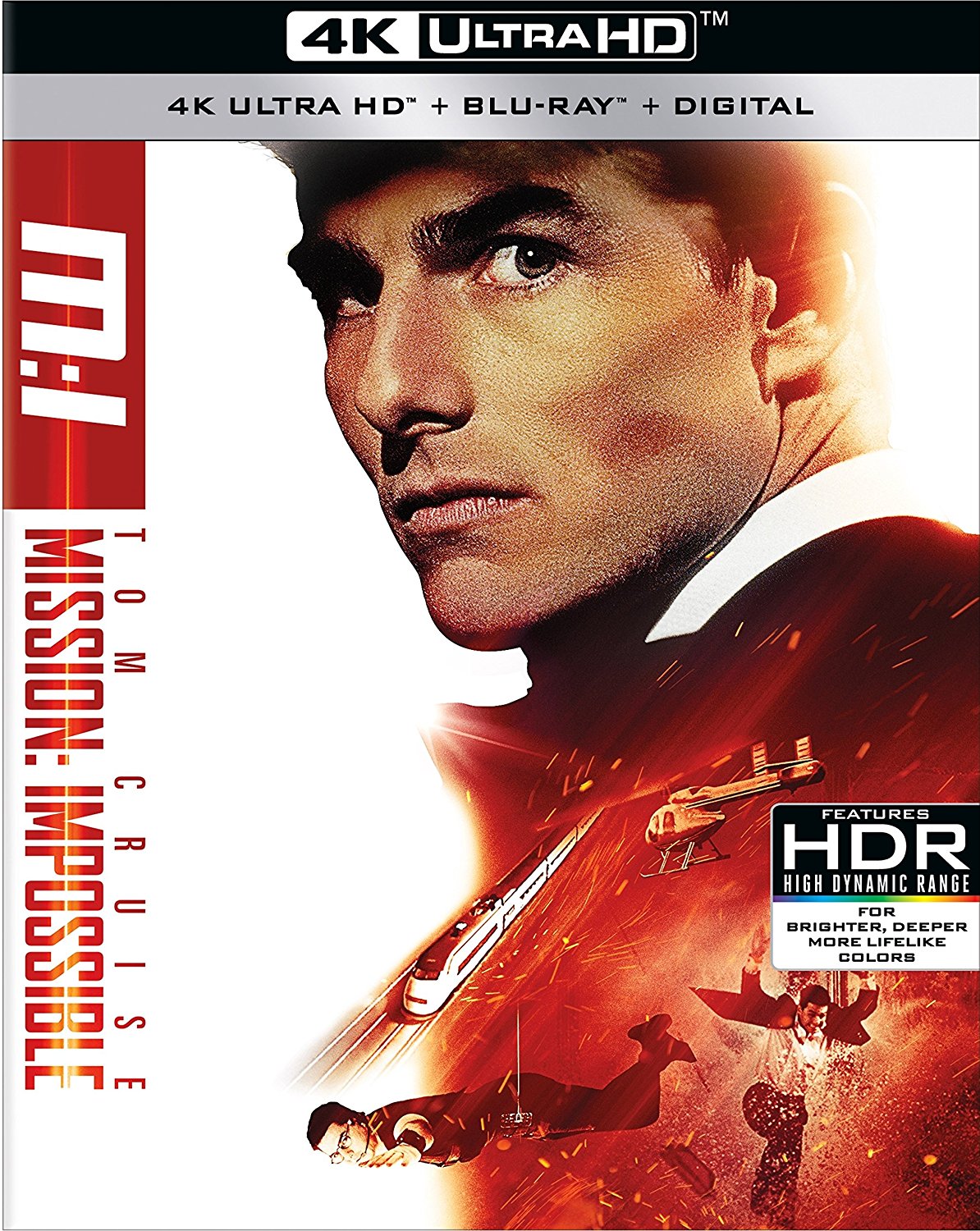
The more things change, the more they tend to remain the same. In 1996 Paramount was nearing the end of a run of feature films that started with a 1960's Desilu Studios television series called Star Trek. That same year the studio was beginning a run of feature films based on a 1960's Desilu Studios television series that at one time shared an actor with Star Trek, Leonard Nimoy. That series was Mission Impossible. The show starred Peter Graves as the leader of a cold war covert government group called the IMF or Impossible Mission Force. Each week he would select from a group of series regulars after getting his mission, should he decide to accept it, from a tape recorder that always self-destructed in five seconds. The tape's dissolving vapor would lead to the fuse being lit that started the opening credits and an iconic theme written by Lalo Schifin. It ran for seven seasons between 1966 and 1973. The series returned for a short while as another television series in the 1980's before it vanished into post cold war oblivion, until Paramount and Tom Cruise decided to join forces and create a new film franchise that has lasted over 20 years and is about to launch its 6th big-budget film.

Sometimes a movie comes along that has everything going for it: a great cast, a great cinematographer, and a decent plot, but when you watch it, you just scratch your head wondering why it ended up so bad.  That in a nutshell is Terminal.  It stars Margot Robbie, Simon Pegg, and Mike Myers, and for each of them I believe this is a film they quickly want to move past. The tagline for the film is Revenge Never Looked So Good, which is a big part of the problem with the film. I absolutely love the look of the film. It’s beautiful and to a point creates its own style I’d call neon-noir, but unfortunately no matter how good something may look, it doesn’t always mean it will be good.

A good portion of the film is about Bill (Pegg), a teacher who is waiting for a subway train but is told by the night janitor, Mr. Franklyn (Myers) that one won’t be coming for hours.  Mr. Franklyn eventually recommends a diner (conveniently called The End of the Line) for Bill to wait.  It’s at the diner where Bill meets the quirky Annie (Robbie), who is his waitress but is also intrigued by his illness.  To add some more padding to the film, we have a pair of hit men who are introduced in the film’s wonky timeline who take a mysterious job that leaves them locked up in an apartment for days as they are waiting for a phone call to signal when the hit is to go down.  How Annie involves herself into the mess with the hit men strays into spoiler territory, but I’ll simply say it was a designed coincidence from sloppy storytelling.

“Please don't do the whole absent-minded professor thing.”

Even though he’s not anywhere close to the biggest name in Hollywood, Guy Pearce is low-key my favorite actor. The Aussie is probably best known for his starring role in Christopher Nolan’s Memento, the memory loss masterpiece in which Pearce played a man who tattooed helpful(?) clues and reminders all over his body. So when I realized he’d be playing another forgetful lead character in Spinning Man, I was hopeful. But despite some solid performances and interesting philosophical ideas, the film is too downbeat and dull to be an effective thriller.

When we first meet the Pierce family it is at the Freeland jail, where Jefferson Pierce (Cress Williams) is there to bail out his oldest daughter, Anissa (Nafessa Williams).  The show doesn’t waste time in tackling social issues as we see them have an encounter with the Freeland police force as they are pulled over for a traffic stop.  The reason for the stop turns out to be they are looking for a suspect who just robbed a liquor store, and because Jefferson is black, he of course is a potential suspect.  Having this scene early on, not just in the season but in the pilot episode, is a bold and important move by the writers.  This shows us that despite being a superhero show, Black Lightning is going to show us a superhero tale unlike anything we’ve seen before on the CW.

Family takes the center stage in this show, and while there is some superhero crimefighting that does get done over the course of the season, watching the Pierce family tackle social issues is just as important.  Jefferson Pierce is a high school principal in a neighborhood that is surrounded by gang violence and drugs.  It’s been nine years since he was fighting crime as the costumed hero Black Lightning. He’s had his costume stashed away in order to raise his family and help the kids at his school, which has made him a valuable figure in the community.  He even mentions early on how he’s saved more kids by being a mentor at his school than he ever did as the masked vigilante.  Seeing Pierce confronting gang members and helping his students is an engaging story already, though it’s something audiences have already seen before (Dangerous Minds, Lean on Me, etc).

“Run, Forrest, run!”

Forrest Gump is one of the most beloved films to be released in the past 25 years. The movie received critical love (to the tune of 6 Oscars, including the Academy Award for Best Picture) and commercial love (this was the highest-grossing film of 1994) upon its release. For better and worse, Gump can be seen as a reflection of its good-natured, dim-witted hero: it's a classic example of heart triumphing over head. Time — and, specifically, the internet — hasn't been nearly as kind to Gump as it has to several other films released the same year, but the movie endures thanks to some unforgettable sights, sounds, and a miraculous lead performance.

Remember when Steven Soderbergh told us he was retiring from filmmaking? Since that time he has been behind two of Hollywood's most unique films in a long time. Lucky Logan was a refreshing kind of heist film that made it more of a comedy with wonderful character studies. Now comes Unsane, which employs a completely unique form of filmmaking itself. The entire film was shot basically on an iPhone. That's not entirely true, because he did use various lens configurations that aren't exactly standard on the typical cell phone. Still, he used the phone as the actual digital recording device. What makes this more unique is that he did this to produce a near-normal film and not the expected "found footage" kind of project that one would expect from a movie made on a cell phone. All of this made me extremely skeptical going in, and I'll admit to avoiding the film a bit. When it arrived on UHD in 4K/HDR, I was even less interested in seeing the results. I don't mind admitting here that I was rather surprised at the film I ended up seeing.

The plot of the film is actually quite compelling. Claire Foy does a tremendous job of playing Sawyer Valentini. Sawyer has just started a new job in a new town, and she's impressing her boss and coworkers. But when a date goes badly, we discover that Sawyer is a badly damaged woman who is here because she's running from a stalker. She's suffering a kind of PSTD that isn't always evident on the surface. She does the right thing. She goes to a facility to talk to a therapist about her issues. The next thing she knows she's given papers to sign, which she does without actually reading them. There's definitely a lesson to be learned here, and Sawyer learns it the hard way. She's discovered that she's voluntarily committed herself for a week at the facility. But before you can say One Flew Over The Cuckoo's Nest, things get intense and much worse for Sawyer. It appears she might be the victim of an insurance scam that could keep her here until her insurance coverage literally runs out. She's also confronted by the man who has been stalking her, who could now be working on the hospital staff.

"Who is Jack Reacher? Born Jack, not John. No middle name. He's a ghost. Served in the military police. A brilliant investigator, troublemaker, too. And two years ago he disappears. You don't find this guy unless he wants to be found." 

We've found him. The character of Jack Reacher comes from a series of thriller novels written by Lee Child. From the very start you know that this is going to be a different kind of Jack Reacher than fans have come to know and love from the books. He’s described as being 6' 5’’ and about 250 pounds. Tom Cruise doesn't really fit any of those description elements. He does, however, fit two very important descriptive elements when it comes to Hollywood. He's still a big name and a pretty reliable box office draw. He also put up some of his own cash to produce the movie. Now that's how you get cast for a part very physically different from yourself.

“If you believe in a goal or dream before it happens, is that real?”

There aren’t a lot of inspirational tales out there for young women who aspire to be athletes. At least not that I have seen. That is why I am sure that Alex and Me is bound to make an impact. This is tale for every girl who aspires for greatness. As a father to an amazing little girl, this really hit home for me. Unfortunately, not so much with my daughter, who is a bit too young to grasp the importance of the message this film is conveying, but I fully intend to keep this movie on hand for when she is old enough to understand.

“I just need you to not freak anybody out tonight.”

Flower ends up being a pretty strong reflection of its promiscuous protagonist: both the movie and the anti-heroine at its center are sharp, profane, a little all-over-the place, and contain a surprising undercurrent of emotion. The movie is a polarizing experience, to be sure, but I enjoyed going on this particular wild, unpredictable ride.

Cinematically speaking, the name Eli Roth has been synonymous with murder and mayhem. The director is best known for his work in the horror genre, bursting on the scene with 2002’s Cabin Fever and upping the ante with Hostel and Hostel: Part II a few years later. So it was a bit surprising to hear he’d be taking on a remake of Death Wish — the iconic 1974 Charles Bronson revenge flick — until I started thinking about the bloody possibilities. If the Hostel films gained notoriety as prime examples of “torture porn,” then it seems like Roth has graduated to “revenge porn” with this slick and (intentionally) silly re-imagining.

“People rely on the police to keep them safe. That’s the problem.”