Studio

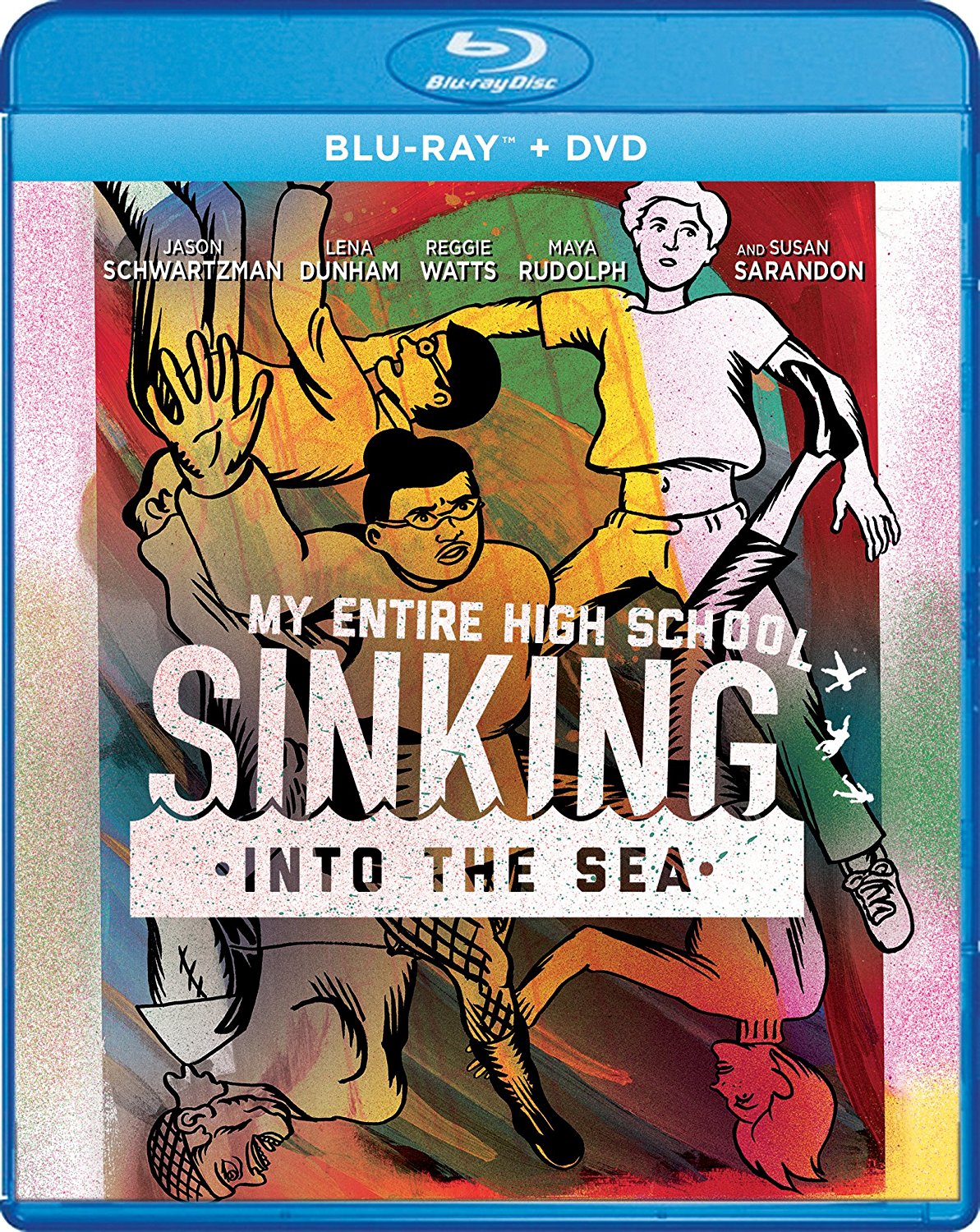
When coming into this film you need to put aside any expectations of seeing your typical Pixar or Dreamworks animated film.  This is arthouse animation that is filled with originality while attacking the clichés we see in big-budget disaster films.  I didn’t really know what to expect from this film, but with a voice cast that includes Jason Schwartzman, Lena Dunham, Reggie Watts, Maya Rudolf, and Susan Sarandon it was such an odd mix that my curiosity couldn’t resist. So is the trippy animated film a success, or is it a dud destined to sink into obscurity?

The film runs at 77 minutes which leaves the film little time to set up characters and plot, but somehow the film still manages to give us a group of fully-fleshed-out characters; though they are a bit exaggerated, they remain relatable. Dash (Schwartzman) and his best friend Assaf (Watts) are returning to school with hopes of being more accepted and respected than they were the previous year.  The friends work together on the student newspaper where Dash enjoys writing exaggerated pieces while his friend prefers to stick to the facts and not blow the story out of proportion. It’s because of Dash’s flare for exaggeration that it’s difficult to find students to believe him when he discovers the school is in danger of falling into the ocean.

Bad Robot, in my eyes, is simply the best at keeping things a secret.  In this day and age, to be able to surprise audiences is just about an impossible task.  When the first Cloverfield trailer was released in 2007 in front of Transformers, it was a trailer that had us all guessing up until its release.  In my opinion Cloverfield was one of the best found-footage films to come out and was a grand achievement, considering it was a monster film that had been pretty much been kept under wraps until its actual release.  Bad Robot managed to surprise us again, releasing a trailer for 10 Cloverfield Lane that set the internet on fire with theories and hopes for this to be a long-awaited sequel.  But is that what this really is? 

What I want to go ahead and get out of the way is, if you’re hoping for spoilers, there will be none, other than to say if you are expecting a big-budget extravaganza filled with monsters destroying cities, this is not that film. You will feel cheated.  Instead, what 10 Cloverfield Lane delivers is something more intimate than I would have expected, and it takes the thriller genre back to its basics.

It might be hard for me to admit, but there are certain instances where having an ultra-high-definition transfer of even a modern film is not necessarily a better thing. The UHD 4K release of Cloverfield is one such instance. There is no question that the transfer is about as sharp and clean as anything I’ve seen on Blu to date. The problem is that it only helps to accent the stylistic flaws inherent in this kind of film. The most noticeable improvement is in the first third of the film. Of course, that part of Cloverfield is about as entertaining as watching paint dry. I still don’t care about these characters and their party ramblings any more now than I did before. The fleeting shots of the creature do look better, but you still better hit the pause button if you want a good look.

The entire film takes place inside the camcorder of a character named Hud (Miller). Hud was given the recorder to document the goings on at a farewell party for Rob (Stahl-David). Rob is about to leave New York for an executive position at a company in, of all places, Japan. I suspect the destination to be one of many Godzilla nods Abrams offers in the film. Hud is doing his duty diligently when the building shakes and half of New York loses power. A television report informs the partiers that an oil tanker has overturned in the harbor near Ellis Island. The people take to the streets, and from here on all of the events are seen only through the lens of Hud’s camcorder. We’re treated to rather fast-paced and too often jarring images of New York crumbling around these people. Buildings collapse in images eerily reminiscent of 9/11. There are explosive fireballs and screaming jets overhead. We hear someone cry that “It’s alive,” and from that moment we get very fleeting glimpses of the large creature causing all of this devastation. It is also shedding smaller parasite creatures that find tasty humans throughout the city. We never really know what this creature is or where it came from. We honestly never get very many good looks at it. Rob wants to go across town and check up on his girl, Beth (Yustman). Wherever our small troop goes, it seems the creature is never far behind.

"Once upon a time there was a great war that brought so much sadness to so many people. Hardly anyone could remember what happiness was like. But something happened that changed all that..."

“Winnie the Pooh doesn't know what to do …” begins a popular song written by Kenny Loggins, recorded first in 1970 by the Nitty Gritty Dirt Band with a more popular and enduring version by Loggins and Messina a year later. Hundreds of millions of children since the 1920's know who Winnie the Pooh is. He's the happy-go-lucky bear who lives in the 100 Acre Wood with Piglet, Tigger, Owl, Rabbit, Eeyore, Kanga, and Roo. But Pooh's best friend of all was a young boy named Christopher Robin. The books have entertained children for nearly 100 years. Walt Disney introduced us to very different but equally as endearing animated versions in the 1960's. The stories have continued with Saturday morning cartoons, feature films, and an upcoming live action Disney production. Pooh and his friends remain a fond memory for most of us. But most of us don't know the story behind the iconic characters. Goodbye Christopher Robin does an admirable job of bringing that story to life as vividly as the stories have brought Pooh to life over the years. But this is not really a happy story at all. Real life seldom is, and I credit director Simon Curtis for being brave enough to tell the unhappy story without so many of the trappings of Hollywood and the need to have our stories end in happily ever after.

Everyone was warned, but no one listened.”

These words — which are about as subtle as a tsunami — are heard in voiceover at the start of Geostorm, the latest effort from master of disaster (films) Dean Devlin. Yes, I realize no one should venture into a big budget flick produced by Dean Devlin (Independence Day, 1998's Godzilla) looking for subtlety. But no matter what side of the climate change issue you fall on, Geostorm is equally offensive to all parties. And it's not because of its politics or its shoddy writing, which gives that opening monologue to a character who ends up being completely inconsequential. It's because this would-be blockbuster is shockingly short on both fun and spectacle.

"The games have begun again, and they will not stop until the sins against the innocent are atoned for."
It has been about seven years since last we heard Tobin Bell ask if we wanted to play a game. From 2004 until 2010 we were treated to seven films in quick succession, with The Final Chapter apparently bringing the popular franchise to an end. But most of us were pretty sure that the end wasn't quite so near. The films brought in billions of dollars and even inspired a new escape room industry around the globe where people could work out puzzles and attempt to beat a ticking clock to get out of a themed room. Of course, no blood gets spilled, but folks pay for the experience, and a lot of that goes back to the Saw film franchise. With all of that money, Lionsgate simply couldn't let the franchise rest for long. But after moving so quickly from film to film, it was a good idea to allow it time to breathe and the producers a chance to recharge the old batteries. Break's over. The franchise gets a bit of a reboot without completely rebooting at all. The result is Jigsaw, and I suspect this is more of a beginning than merely Saw 8.

Jigsaw is the first film in the series to begin with something other than victims awakening to the newest trap. Police are chasing a suspect with a detonator in his hands. He's pleading to talk to a Detective Halloran (Rennie). As the cops descend upon the manic suspect, he warns that the game is about to start. It's what fans are waiting for, and we cut to five people with buckets bolted to their heads attached to chains. A wall of the obligatory saws awaits their hapless forward plunge, and a familiar voice explains their predicament. From this point there are pretty much two stories playing out for the remainder of the film.

During the second half of My King/Mon Roi — which examines the up-and-down nature of love by chronicling a 10-year relationship between two French lovebirds — a wife states that her husband's constant emotional abuse has caused her more pain than any single punch ever could. Psychological abuse isn't nearly as cinematic as its physical counterpart, so it's a jarring, too-real-for-TV moment to witness on screen. My King has a handful of those gut-punch scenes. And since the movie intentionally mimics the rollercoaster relationship at its center, My King is also occasionally romantic, funny, frustrating and flat-out sexy.

The knee signifies the capacity to let go, give way, or even retreat...”

Have you ever heard the legend behind the legend of Ninjago?”

Even though I loved the first two Lego movies, I was completely unfamiliar with the toy company’s Ninjago line before I sat down to watch this latest entry in the madcap cartoon franchise. (I wasn’t even sure how to pronounce “Ninjago”…and the answer isn’t as simple as it seems.) But my unfamiliarity with the source material isn’t the reason why I feel The Lego Ninjago movie is the weakest entry in the series so far.

In case you’ve been living beneath a rock and out of contact with any and all social media, this weekend the long-awaited film adaption of Stephen King’s It releases. Some of my friends look at the trailer for the new film and instantly reject what they see; they immediately cling to their memories of how the original mini-series scared them. One thing you’ll hear them all saying is how Tim Curry made such an impact on their lives and to this day gave them reason to fear clowns. While I respect their opinions, when you revisit the film, you can’t help but notice how dated the film is, and really, if you’re over the age of 10, it just isn’t scary. I grew up on reading Stephen King, and as a fan, I’ve always been frustrated that it seems no one could ever get his horror stories right. Sure, there is Misery and Carrie, but there are many more miserable failed attempts of his material.  The Mist (especially the black and white version) is perhaps my favorite adaption of his work, that is to say, up until now.

When the film starts up, those of you familiar with the mini-series will perhaps have a sense of déjà vu at first. Without a doubt our first introduction to Pennywise, the dancing clown, is at first a little off-putting, but if you hang in there, you’re going to be happily terrified by this performance. Bill Skarsgard fills the clown shoes this time around, and there is no doubt a new generation of kids are going to be terrified of clowns because of this performance.  There is nothing friendly in this performance, and after our introduction and we get a glimpse at what he’s capable of doing to children, that’s when the unease sets in, and as an audience member you realize from the start that no one in the film is safe.

Most people that survive a near traumatic experience don’t go back for seconds. Most people that is. For the group in The House October Built 2, I guess they were adhering to the logic that lightning doesn’t strike the same way twice. Or does it? Embarking on what I can only describe as a horror tour, five friends attempt to capitalize on potential fame and fortune by documenting their experience traveling city to city to explore various haunted houses or hay rides. They even managed to convince the most traumatized member of their group to join them, reopening old wounds and provoking things that best left in the past. I wish that was the worst they had to contend with, as evidence that what they faced a year earlier begins to resurface to finish what it started.

So the concept of the film is top-shelf, execution is another matter in entirely. For one, the set-up is entirely too long. The basic idea was apparent early on, this group looking to capitalize on their famed abduction a year earlier resumes the same activities that nearly cost them their lives. I even enjoyed the addition of a holdout, the girl that refused to take part in this after being buried alive in a coffin. I mean, who would want to relieve that trauma. However, once you have the girl on board, I would say that you only need to visit a handful of places to establish tempo before moving to the center stage for the plot. I think a part of it was the fact that the group went to around three venues before they realized that they need the girl. In my opinion, they should have found themselves turned away at the first venue in order to necessitate the need for their holdout and those other two venues could have been focused more on convincing her to jump back into the mix, possibly a flashback to the year prior.