2:39:1 Widescreen

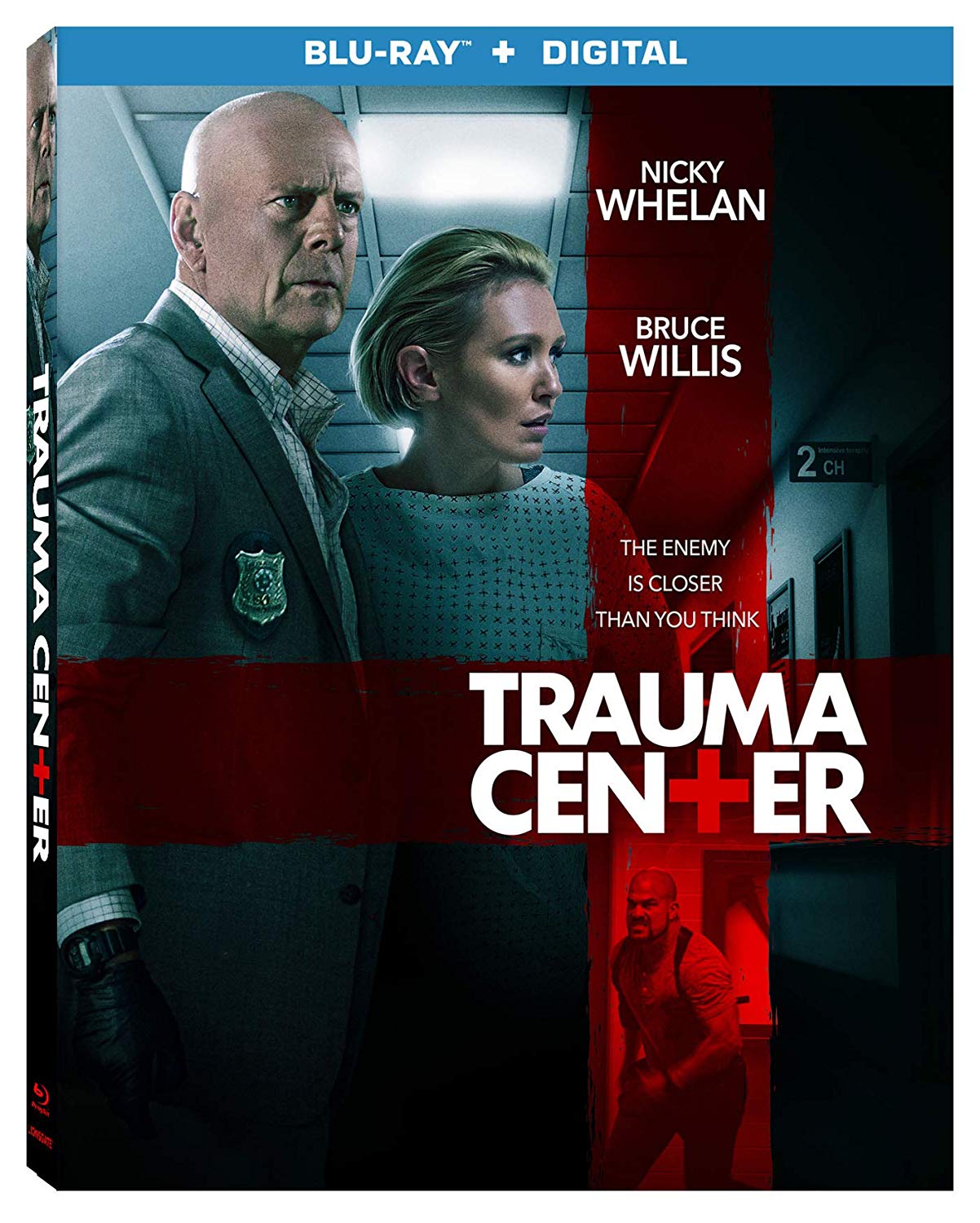
I’ve gotten used to the cinematic disasters Bruce Willis has attached himself to over the past few years.  I’ll admit, I was surprised to see him in Motherless Brooklyn, and after his impressive performance in Glass, I had hoped he was going to attempt to get himself in to some higher caliber films.  Willis has stayed in shape, especially for an action icon who is getting up there in his years, and he still manages to have a presence when he appears on screen.  Sure, I get that we can’t expect him to keep throwing himself out of exploding buildings and having elaborate fight scenes. In a perfect world, I’d love to see him be able to revisit the role of Joe Hallenbeck in a The Last Boy Scout sequel. Heck, while staying on the nostalgia train, I’d be on board with a Hudson Hawk sequel over some of these direct-to-video films he’s been doing.  Getting back to Trauma Center, we have a new direct-to-video action film that features Willis attempting to save a young girl’s life who happened to be at the wrong place at the wrong time. Is the film worth checking out, or is it one you should simply pull the plug on and avoid?

Madison (Nicky Whelan) and her little sister, Emily (Catherine Davis) have relocated to Puerto Rico after their family has been struck with tragedy.  Madison is struggling to do what she can to take care of her sister, but it’s been a bumpy road for the two of them.  Emily also has asthma, which means in cinema terms, at any moment she can die if she’s overly excited.  As it turns out, it’s an asthma attack that lands Emily in the hospital where she needs to stay the night so she can be monitored.  While this family drama is going on, there are a pair of corrupt vice cops who are trying to locate a snitch who has evidence on him that could put the two away.  This introduces Lt. Wakes (Willis), who is asked to check in on the informant and ends up discovering the dead body of the informant.

When we last saw the Mistress of Evil (which also happens to be the title for the sequel) she was more of a hero rather than a villain. However, the sequel sees her return to her previous status as the feared fairy that ruled the Moors. How quickly people forget her contributions. Though not traditionally scary, the film features plenty of magic and carnage courtesy of Jolie. Additionally, the film features the return of Elle Fanning, Sam Riley, and Harris Dickson as Aurora, Diaval, and Prince Philip. With the addition of Chiwetel Ejofor and Ed Skrein, as well as Michelle Pfeiffer as Queen Ingrith, Philip’s mother, who gives Maleficent a run for her money for the title of Mistress of Evil. In the five years that have passed since then the original film, Aurora has continued to reign as Queen of the Moors and is beloved by her subjects, and especially by Prince Phillip, who works up the courage to propose marriage. Aurora accepts, but then comes the hard part: telling their parents. For Phillip the difficulty comes from her mother, who feels that their people have a right to pillage the Moors and worries about losing her son to Aurora, who rules the land she would like to acquire. For Aurora, the difficulty is much more challenging, as she has the unfortunate task of telling her godmother, the protector of the Moors, Maleficent. Though initially opposed to the idea, Maleficent grants her permission. However, this is only the beginning of their troubles.


At a formal dinner to celebrate the union, heated words lead to a declaration of war between the two kingdoms, as well as a curse. As a result, a rift is formed between Maleficent and Aurora, who sides with her new family. Adding to the situation, Maleficent suddenly learns that she is not alone in this world, as she discovers more like her and her origins.

Back in the 80’s and 90’s it was a glorious time for crazy, over-the-top action films. The names that most notably come to mind when I think of this time in action cinema are Don Simpson and Jerry Bruckheimer.  They were the guys who knew how to make a popcorn action film: Beverly Hills Cop, Days of Thunder, Bad Boys, and many more. While Line of Duty isn’t quite in the same league of these films, it definitely has its roots in these films, and for a VOD action film, well, this film is all kinds of absurd fun.   Director Steven C. Miller has had some duds over the span of his career, though I did enjoy his take on Silent Night, but Line of Duty shows that the man is capable of helming a white-knuckle action film if given a proper budget and script to work with. When it comes to Aaron Eckhart, I’m kind of surprised we don’t see him as the lead in more tent pole action films.  Sure, many of us know him for his turn as Harvey Dent in The Dark Knight, but he’s a guy with so much untapped talent. It was nice to see it on display in this film. Frank Penny (Eckhart) is a disgraced cop who is responsible for getting a kid killed and is now stuck working as a beat cop.  It doesn’t take long for the film to ramp up as Frank is caught up in a foot chase with a suspect involved with the kidnapping of the chief of police’s daughter.  There is a lot of running in this opening act, and things go bad to worse for Penny when he’s put in a situation where he kills the only lead to finding the kidnapped daughter.

Miller does a good job at sucking us into Penny’s world and sympathizing with him, but the film unfortunately takes a miserable turn with the introduction of millennial, social media reporter Ava (Courtney Eaton).  Maybe I’m showing my age, but geez, was I annoyed by the introduction of this character. Even worse is the character Clover who runs the site Ava reports for.  I know it’s only January, but I’m quite certain the character Clover will be the worst character of the year, from her actions and dialog in the film, she’s basically the millennial character everyone rolls their eyes in annoyance over.

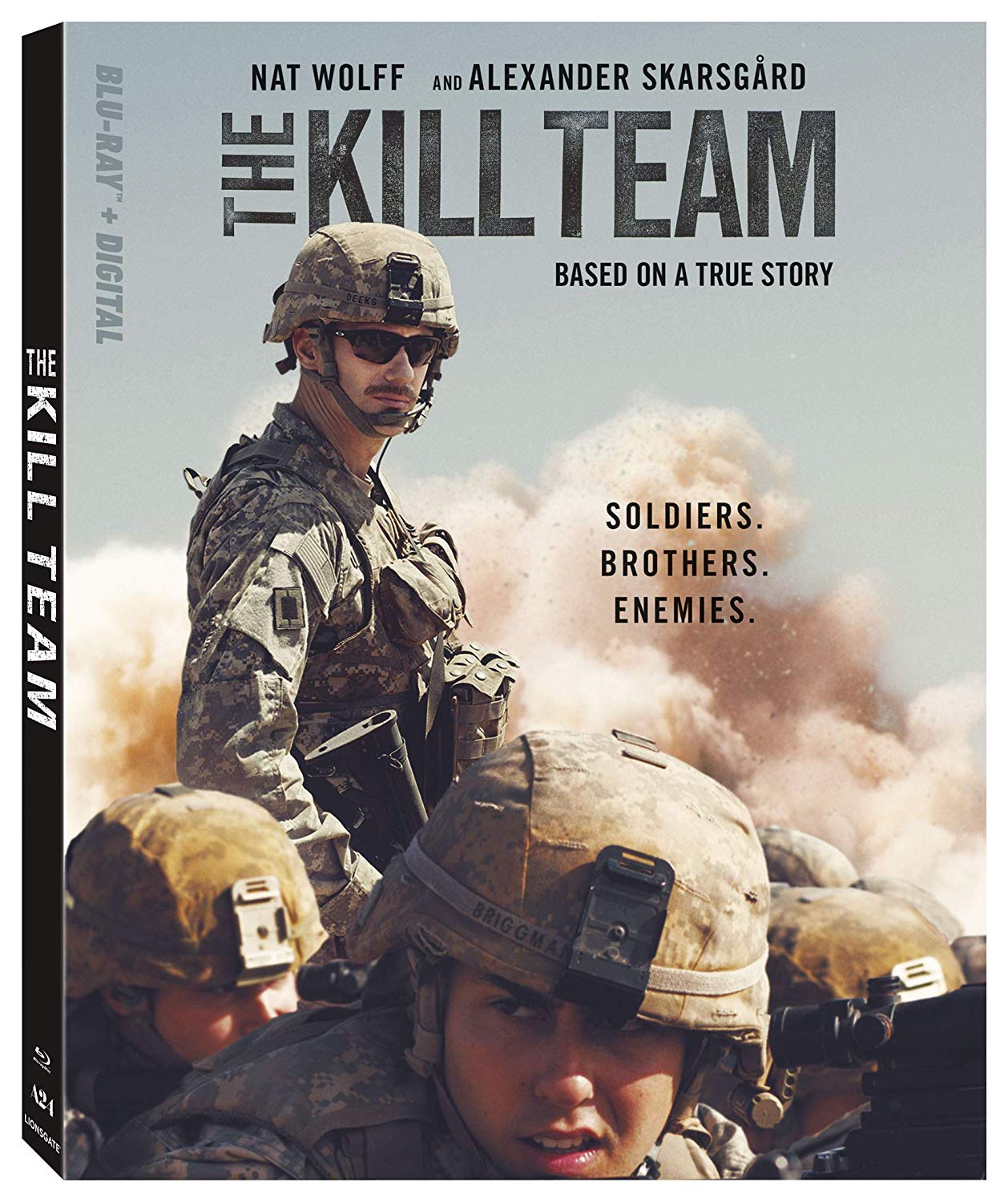
This is yet another war film that is “based on true events”.  Considering how long troops have been over in Afghanistan, it’s no surprise how many films seem to be coming out about the subject.  I’ll admit going into this film I didn’t exactly have high hopes, but I’m pleased to say not only did the film not disappoint; I found myself actually enjoying it. Granted this is no 1917, but it’s definitely better than the dumpster fire film that I reviewed about a month ago called D-Day.  The Kill Team follows new recruit Andrew Briggman (Nat Wolff), who is wide-eyed and ready to see combat, but once he is confronted with the very human side of the war that the troops are facing, well, his conscience begins to weigh him down, and things only get more complicated for him as his time in Afghanistan stretches on.  From the start, the film seems to have a very idealistic view on how the soldiers can and should act, and it’s this “moral compass” that gets in the way of telling the story.  When it comes to war films that delve into the cruelty that occurs, you can’t let morals dictate the story. It’s the equivalent of doing a western where the bad guy wears the black hat and the good guy wears white.  Sure, you’re spelling it out for your audience, but when depicting real life, it’s never quite that easy to tell wrong from right.

The film wastes no time in getting us into the story, as we see Briggman on his last day being a civilian to him being in Afghanistan.  He seems disappointed that instead of seeing combat he’s stuck with his team travelling to villages attempting to build relationships with them, but things quickly go sideways after an explosive takes out his Staff Sergeant.  It doesn’t take long before a replacement comes in, and it’s Staff Sergeant Deeks (Alexander Skarsgard) who comes in to make some changes to the unit. He’s not about being friendly with villagers; instead, he’s ready to hunt down some bad guys responsible for making bombs that have killed numerous soldiers over the year.  Here’s the thing: I was onboard for this being about a military unit simply out for blood killing potential terrorists. If you’re going to do a film about morally corrupt soldiers, I figure you just go all in and make them a ragtag team of anti-heroes.  Well, writer and director Dan Krauss had other plans, and instead focuses on the inner termoil Briggman is going through about his unit murdering “innocent” people.  Because Krauss previously directed a documentary about soldiers that were involved with the same situation, he uses his insight to deliver a very grounded take on the subject matter.

"The near future. A time of both hope and conflict. Humanity looks to the stars for intelligent life and the promise of progress. To the stars..."

You know a movie’s bad when Brad Pitt isn’t enough to save it. However, where Ad Astra falls down is in execution of story rather than a failure on the part of Mr. Pitt. The premise was interesting: a son follows in the footsteps of his hero astronaut father to learn that his father, who was previously believed to be dead, may be responsible for catastrophic events plaguing the Earth. There is depth to the story, and the idea of human beings colonizing other planets was shown in a truly interesting and realistic manner, but instead of this being the forefront of the film, the story focuses primarily on a emotional journey that never pans out. The film also features a cast of superstars whose performances were little more than cameos. A waste of talent, if you ask me. I mean, why put together a cast that includes Tommy Lee Jones, Donald Sutherland, Liv Tyler, and Ruth Negga, just to have their contributions be the length of a commercial. Yes, I know that was an exaggeration, but it just seems wasteful.

Downton Abbey spent six years on television and has amassed 52 episodes. In that relatively short run the series has also managed to collect over 200 award nominations and several Golden Globes along with other prestigious awards. Let's not forget a rather loyal fan-base that has watched each episode with anticipation of the next sharp barb or character revelation. The fans have been vocal and strong enough that a new film franchise has been anticipated to fill the void left by the series. In one of its years it was the number-one binged series in the world. That's a lot of power, and it's little wonder that all of these ingredients are expected to create a little box office gold. But film franchises from television shows rarely go on to such golden heights. There are some notable exceptions, to be sure. But even here, expectations and changing caretakers often lead to both high points and flops. The Star Trek franchise is a perfect example of those kinds of ups and downs. Mission Impossible is an example of shows that have to be completely retooled to hit the high numbers. Where will Downton Abbey fit in this equation? I rather suspect the jury is still out. One thing I can tell you with complete confidence: the film will absolutely entertain fans of the series. There's no retooling to be found here, and you can expect the same kind of drama that you've been mainlining for 52 episodes.

The original series left the Crawley family at the Christmas of 1925. A little over two years have passed, and we rejoin the family in the summer of 1927. The family appears to have come to a point where they have to face the possibility that the aristocracy in Great Britain might be finally coming to an end. There is much conversation about having the family finally give up Downton Abbey and place themselves into somewhat normal British society. The manor doesn't bring in the kind of wealth it once did, and keeping it going will require making some serious cuts and sacrifices. Amid this crises of conundrum, Robert Crawley (Bonneville) is informed that the King and Queen of England have decided to visit the Abbey and spend an evening there. The occasion brings about a flurry of preparations. One of these preparations involves the newly promoted butler. Thomas Barrow might not have the right experience or demeanor to handle such a huge job. Lady Mary (Dockery) decides to reach out to their seasoned but retired former butler, Mr. Carson (Carter). It's actually a quite clever way of giving the show some kind of major story and a great excuse to bring back the familiar character so that fans can get at least one more visit with things very much as they were at Downton Abbey.

“This meeting of the Losers’ Club has officially begun.”

I don’t think I’d be exaggerating by saying It Chapter 2 might be the most highly anticipated horror film in quite some time. Two years ago when the first It hit the cinemas, sure, I expected it to be a hit, but the film went on to be a pop culture sensation.  Pennywise was already well known because of the books by Stephen King, but also because of the loyal fan base of the 90’s mini-series.  Debates were heated about which Pennywise was better and more terrifying, while other debates went on about which adaptation was better.  I always felt it was unfair to compare this new version to the mini-series simply because we only had half a film, and now finally this weekend we have the conclusion to the story about our favorite Losers’ Club, only instead of teenagers they are all grown up.  Now that the wait is over, how does this film stack up alongside the first half and the mini-series? Well, I’ll say it’s better than the mini-series but doesn’t quite have the magic of the 2017 film.

"This is a story about control. My control. Control over what I say. Control about what I do."

Hustlers tells the "true" story of a team of strippers who found a way to turn the tables on their Wall Street clients and is based on a New York Magazine article by Jessica Pressler. It promises a pretty good time. I mean, think about it. Wall Street is the stuff of mustache-twirling villains these days. Brokers might have dropped beneath ambulance-chasing lawyers and used car salesmen as the people we love to hate. Throw in some strippers and a clever con that happens to target these modern bad guys, and it sounds like the kind of romp that has something in it for everybody. Well ... maybe not the Wall Street guys who go to the movies, you might say. Did I mention it's got strippers? At first blush the film reminds me a little too much of Paul Verhoeven's infamous Showgirls. The problem is that the schlock value of that film has allowed it to find its place in film history, and so it has survived in all its badness. Will the same be true of Hustlers? Or will it quickly vanish into a sea of obscurity before another couple of years are over? I have to say that I suspect it's the latter. By this time next year, you'll be asking a friend what the name of that stripper film with Jennifer Lopez was last year. Let me know if anyone remembers, won't you?

The most amazing thing about The Handmaid’s Tale — other than a powerhouse lead performance from the best actress working in television right now — is that this harrowing, suddenly timely cautionary tale about what happens when society falls asleep at the wheel is based on a story that was published more than 30 years ago. Of course, the show has a lot more going for it than impeccable timing. The Handmaid’s Tale is based on Canadian writer Margaret Atwood’s 1985 novel of the same name. Sometime in the not-so-distant future, the world is in chaos after environmental pollution and sexually transmitted diseases result in a catastrophic decline in human fertility rates. In the U.S., the result was Second Civil War, which led to the establishment of a totalitarian, Christian fundamentalist government known as Gilead. And while life isn’t exactly a picnic for anyone outside of Gilead’s elite ruling class, life is especially dire for women: they are not allowed to own property, work, handle money, or read. Much of this information is revealed in dribs and drabs over what is now three seasons.

The Handmaid’s Tale is created by Bruce Miller, a writer producer who worked on SyFy’s Eureka and The CW’s The 100. The former series offered a cracked-mirror, off-center version of reality, while the latter is a post-apocalyptic drama: both sensibilities proved extremely beneficial for Handmaid’s. A large share of the credit also goes to Reed Morano, who won a directing Emmy for her work on the pilot and established the show’s spellbinding visual tone by helming the first three episodes.

I have to be honest; when I got this title and saw that Jim Gaffigan was starring, I didn’t know what to expect, but I went into this film with some low expectations.  I’m a fan of Gaffigan, and I own a few of his stand-up albums, but seeing him headlining a thriller, well, it was a tough leap for me.  Now that I’ve seen the film, I got to say I’m impressed by what he pulled off with this film.  That being said, as I was watching this film, I couldn’t help but see a similarity between Gaffigan and the late Philip Seymour Hoffman.  I doubt this was intentional, and perhaps it’s just my subconscious attempting to make these connections, but Gaffigan’s performance in this film  is on par with many of the performances we saw from Hoffman in his later years. As for the film, American Dreamer follows Cam (Gaffigan), a down-on-his-luck schlub who at one point was living the American dream: a good job, a nice home, and a wife and child.  Then he lost his job, and everything else seemed to disappear around him. Now he’s a driver for a ride share company, where he struggles with paying child support and has had a bit of a mental breakdown.  Early in the film we get to see him in a parking lot near an airport, watching as planes are coming and going, and its obvious Cam is dreaming of an escape from his life.  He ends up getting a fare that has him driving a small-time drug dealer, Mazz (Robbie Jones) around town. The setup here seems simple, as it establishes who both of these men are, but over the course of one night we’ll see these men make some difficult decisions, and by the time the film ends, you will definitely feel differently about these characters.

After reading the blurb on the back of the Blu-ray and starting this film, I was a little worried that this would be something akin to Collateral meets Falling Down. When we see Cam come to his breaking point and he decides to kidnap Mazz’s son, sure, it’s a drastic leap for someone to make, but the way the writers and director handle this situation, it still remains in the realm of possibility.  That pretty much is how the rest of the film plays out; there are a lot of worst-case scenarios that happen to both Cam and Mazz, and it’s what keeps the viewer on the hook.  What I was most impressed by is how co-writer and director Derrick Borte wasn’t afraid to go dark with this film, because there are a few decisions made in this film that are pretty risky, and most filmmakers would avoid entering this territory, but personally I think it’s the risk that makes this film work. (It would be a huge spoiler if I were to say what this risk was.) But by taking that risk, the viewer knows anything can happen in this film. and it’s what literally kept me guessing at how this would all end for Cam and Mazz.