




“Yes, this is Sunset Boulevard, Los Angeles, California. It’s about five o’clock in the morning. That’s the Homicide Squad – complete with detectives and newspapermen. A murder has been reported from one of those great big houses in the ten thousand block. You’ll read about it in the late editions, I’m sure. You’ll get it over your radio and see it on television, because an old-time star is involved – one of the biggest. But before you hear it all distorted and blown out of proportion, before those Hollywood columnists get their hands on it, maybe you’d like to hear the facts, the whole truth. If so, you’ve come to the right party. You see, the body of a young man was found floating in the pool of her mansion – with two shots in his back and one in his stomach. Nobody important, really. Just a movie writer with a couple of ‘B’ pictures to his credit. The poor dope! He always wanted a pool. Well, in the end, he got himself a pool – only the price turned out to be a little high. Let’s go back about six months and find the day when it all started.”
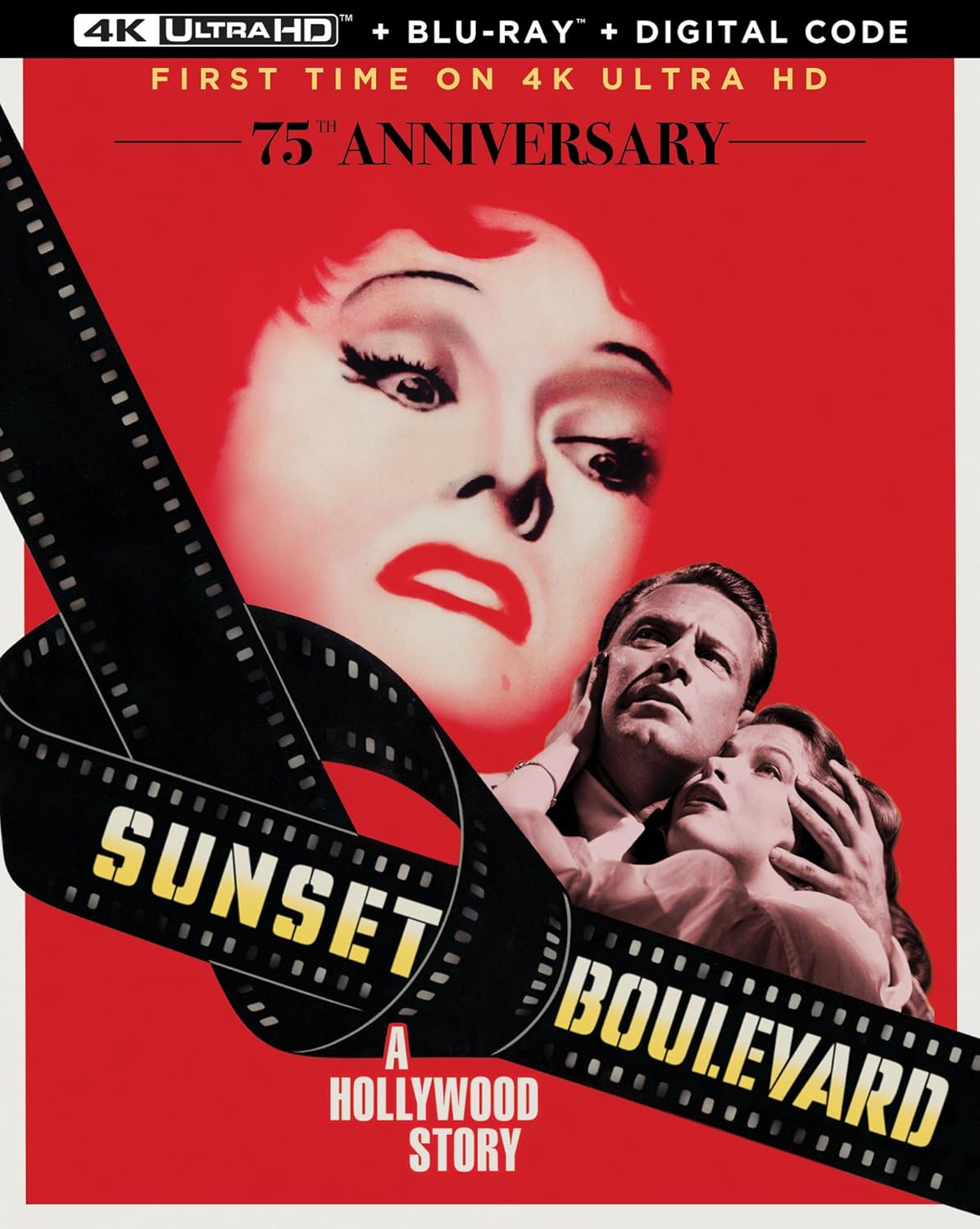
The term “classic” is misused these days. I know many fellow critics who fall in love with too many films and rate them high with the idea they are going to be “classics”. More times than not, in five years, let alone 50 or 75 years, no one has even heard of or remembered the movie. The truth is that kind of high-end designation can’t be made for at least 20 years. I don’t give out very many 5-disc ratings. Far less than anyone else on the site, and with literally thousands of more reviews to count. Sunset Blvd. is one of those films. If you’re still quoting a film 75 years later? That’s the very definition of a true classic, and Billy Wilder’s film passes anyone’s grade for that distinction. I know that IMDB presents the film as Sunset Boulevard, as do some of the film’s posters. On screen and in the copyright filings for the movie it is Sunset Blvd., and that’s how I will refer to it here.
“It was a great big white elephant of a place. The kind crazy movie people built in the crazy 20s. A neglected house gets an unhappy look. This one had it in spades. It was like that old woman in “Great Expectations”. That Miss Havisham in her rotting wedding dress and her torn veil, taking it out on the world, because she’d been given the go-by. Come think of it, the whole place seemed to have been stricken with the kind of creeping paralysis … out of beat with the rest of the world … crumbling apart in slow motion. There was a tennis court … or rather the ghost of a tennis court … with faded markings and a sagging net … And of course she had a pool. Who didn’t then? Mabel Norman and John Gilbert must have swum in it ten thousand midnights ago … It was empty now. Or was it?”
When we are first introduced to William Holden’s Joe Gillis, he’s the stiff floating in the pool. No real spoiler here, because he fills you in from the start. The film is the story of how he got there. The film’s original working title was A Can of Beans, and director Billy Wilder had decided we should meet Joe Gillis not at the scene of the crime, but rather already at the morgue. The change caused a split in the 13-year relationship Billy Wilder had with writer Charles Brackett. It was a costly rewrite for the iconic director, and one that would prove for nothing. Test audiences were rolling with laughter at the talking stiff in the morgue, and so the original opening was restored. What could not be restored was the profitable collaboration between Beckett and Wilder. The original scene was necessary for reasons beyond audience’s amusement. Starting at the mansion and the pool allows the camera to catch the street designation of Sunset Blvd., and it all comes together in one moment to launch us into this classic movie.
“Around every corner, Norma Desmonds … more Norma Desmonds … and still more Norma Desmonds.”
Joe takes us back six months. He’s a struggling screenwriter who is trying to get his baseball script picked up by a movie studio. It’s a wonderful idea using a baseball script here, because the film takes us inside of the potential dark side of the movie industry, and the term for that kind of a movie is called “inside baseball”. In his travels Joe ends up with his car breaking down near the mansion of Norma Desmond, played by Gloria Swanson. Norma is a silent-era star. It’s obvious she was huge by the wealth exhibited in her home. But she’s been cast aside by an industry that is now obsessed with sound, and now Norma Desmond’s days in the hot white spotlight are behind her. And that’s where she lives. She’s become a recluse, as much a part of the collection of antiques as any of the memorabilia and curios that clutter the museum-like residence. She has been served faithfully by the one man she feels never turned his back on her. It’s an ex-husband who has become her butler and caregiver. That role is an underrated role played by Eric von Stroheim. Stroheim was once one of Swanson’s directors. He directed her own attempt at a “comeback” (or as Norma would prefer, return) with a film called Queen Kelly, but it ran out of money and was never released, so that the relationship between actors and characters here truly mirrors reality to a certain extent. Stroheim puts on a performance that hints at horror star Bela Lugosi’s style, and I guess we could call him the museum (and Norma’s) curator. Joe’s arrival is about to change all of their lives.
“I am big. It’s the pictures that got small.”
Norma naturally clings to this young man who happens to be a screenwriter and plots out that return to stardom. Joe would live there and become something of a companion and the writer for their movie which will end up being pages and pages of Norma’s mental state. A wrench is thrown into it all when Joe happens to run into Betty, played by Nancy Olsen. She’s pretty and bright, and they fall into a relationship while writing their own script. With this quartet of actors/characters the stage is set for an intimate and compelling story that will not only become a classic but cause waves throughout Hollywood.
The movie ends up collecting pieces from several film styles, and the combination builds atmosphere, yet leaves the viewer with a bit of an uneasy feeling about what you’re seeing. It’s not a comfortable film to watch, and that has everything to do with Gloria Swanson. While she certainly understood Norma’s feelings, the actress was never mentally unbalanced as Norma most certainly is. She lives in a past that may not have ever existed. That’s an easy thing to write on a page, but I don’t believe anyone has sold it like Swanson does here. I have rarely encountered a performance that felt this visceral or real before or since. Many have come close, but Swanson deserved an Oscar for the performance but had to settle for a nomination. To paraphrase another popular baseball term: she was robbed.
Joe’s narration had a decidedly film noir element, and you can picture these words coming from Bogart. Today the dialog will appear cliché, and that’s true only because of how well the genre did over the decades. There are also elements of German expressionism in a lot of the lighting and shadows. There’s a scene where we get a brightly lit Norma face, white with light and pancake against a stark background. It’s the kind of image you would have expected from the likes of Fritz Lang. And it isn’t even any of these elements by themselves that makes this a great movie. Billy Wilder tapped into something here, as each part of this recipe creates something very different from anything that’s come before or after. This was truly an original movie, from the performances to the production design and the cinematography.
Studio moguls were angry, with one confronting Wilder at the premier. Not all of Hollywood was upset. Swanson brings some of her old friends along for the ride. Buster Keaton would be there for a cameo, along with composer Jay Livingston and another silent screen star, H.B. Warner. Swanson worked with Cecil B. DeMille, and he cameos as himself in one of the film’s best and most touching scenes. She gets a call and believes DeMille wants her to star in his next picture. But really they just want to rent her car. DeMille treats her like the star she was and delivers a poignant performance, as he can’t help but feel tremendous sorrow and affection for the woman. There’s a moment when an old friend on the spotlight puts it on Norma, and for a brief moment she’s transported back to her stardom days, and DeMille’s film crew offer their affection to her. But then it’s back to business. DeMille was working on Samson And Delila during the shoot. This scene took place on the set of that shoot, but not really. He had pretty much wrapped that part when the scene takes place.
William Holden truly established himself as a leading man here. It’s his best film, and it led to some choice roles in the future. It must be hard playing a walking dead man. He’s not really overly sympathetic here, and Joe himself appears to agree that he got what he deserved. It’s Norma’s final complete break from reality. Holden was not the first choice for the role, as Swanson was not the first choice for hers. The Joe Gillis part was written for Montgomery Clift. When he dropped out, both Brando and Gene Kelly were recruited for the job before it fell to Holden. Larger-than-life Mae West was originally to play Norma, and I just can’t imagine the movie with her in the role. It would have been a very different kind of film. I can picture Norma telling Joe to come up and see her sometime. The movie was also the last feature film released on nitrite film. The problem with nitrite film is that it’s unstable and highly combustible. Many films have been lost to history because of that issue, and we can be thankful a print survived for the 4K negative scan.
Video
Sunset Blvd.is presented in an aspect ratio of 1.37:1. The ultra-high-definition 2160p image is arrived at by an HEVC codec with an average bitrate of 75 mbps. Because this movie was shot on 35mm film, it is naturally 4K. The negative was scanned in 4K, so we have a wonderful ultra-high-definition image presentation. Many folks don’t understand how important something like HDR is to a black & white movie. The truth is that it’s maybe more important. In this kind of a film a lot of information depends on subtle shading and a very well-defined level of contrast, and that’s what you get here. HDR is not just for more vibrant and accurate colors. Black levels are deep here, and with a film that depends on light and shadows for atmosphere, this thing was restored to near perfection. There are no print artifacts or flaws here. Some grain appears to be washed with DNR, but it’s still present and provides that organic feel to the whole thing. Details allowed me to see more of the rich production design inside Norma’s mansion and likely gave me an even greater appreciation for the film.
Audio
There is a Dolby TrueHD 5.1 mix as well as the original 2.0. I was fine with 5.1. The surrounds don’t really play into it at all, but it does give the audio presentation some depth from your sub. That helps particularly in the dialog, which dominates the film. Thankfully the presentation doesn’t try to expand and “modernize” the experience. It’s clear and minimalistic, just as it should be.
Special Features
The extras are merely ports of the vintage features that have been around since 2008.
Final Thoughts:
I love this film, and its release now on UHD Blu-ray in 4K is truly a must-have in anyone’s film library. I got to talk about the film with friend fellow critic and host of ReelTalk, R. L. Terry over at WKCG radio. You can check those guys out HERE. Unfortunately it’s radio and not television, because I’m telling you right now: “I’m ready for my close-up.”
