Genre

We all know what it feels like to nod off in the middle of a film. It starts with micro-naps that last a few seconds. They’re so short, we don’t even realize we’ve fallen asleep. But when we wake up, we feel totally lost because we’ve missed a line of dialogue or scene transition. I mention this for two reasons: 1.) the confused protagonist of Tomorrow You’re Gone floats through his life in a dream-like state and 2.) watching this incomprehensible mess of a movie constantly made me feel like I’d fallen asleep and missed something. That’s a problem because I was wide awake.

The plot of Tomorrow You’re Gone — based on the novel “Boot Tracks” by Matthew F. Jones, who also wrote the screenplay — is straightforward enough. We meet Charlie Rankin (Stephen Dorff) just as he’s about to be released from prison. He receives an encoded letter from Billy “The Buddha” Pettigrew (Willem Dafoe), Charlie’s former jail-house mentor. The hidden message orders Charlie to carry out a hit, and Charlie agrees because he feels indebted to The Buddha. On his way to do the job, Charlie meets Florence (Michelle Monaghan) a flirty oddball/former porn star, and the two form an uneasy bond. After the hit doesn’t go as planned, Charlie has to dodge an unhappy Buddha. (He also spends an inordinate amount of time dodging Florence’s sexual advances because...actually, it’s not really clear why he keeps rejecting this woman who is throwing herself at him. It flies in the face of everything we know about movie ex-cons.)

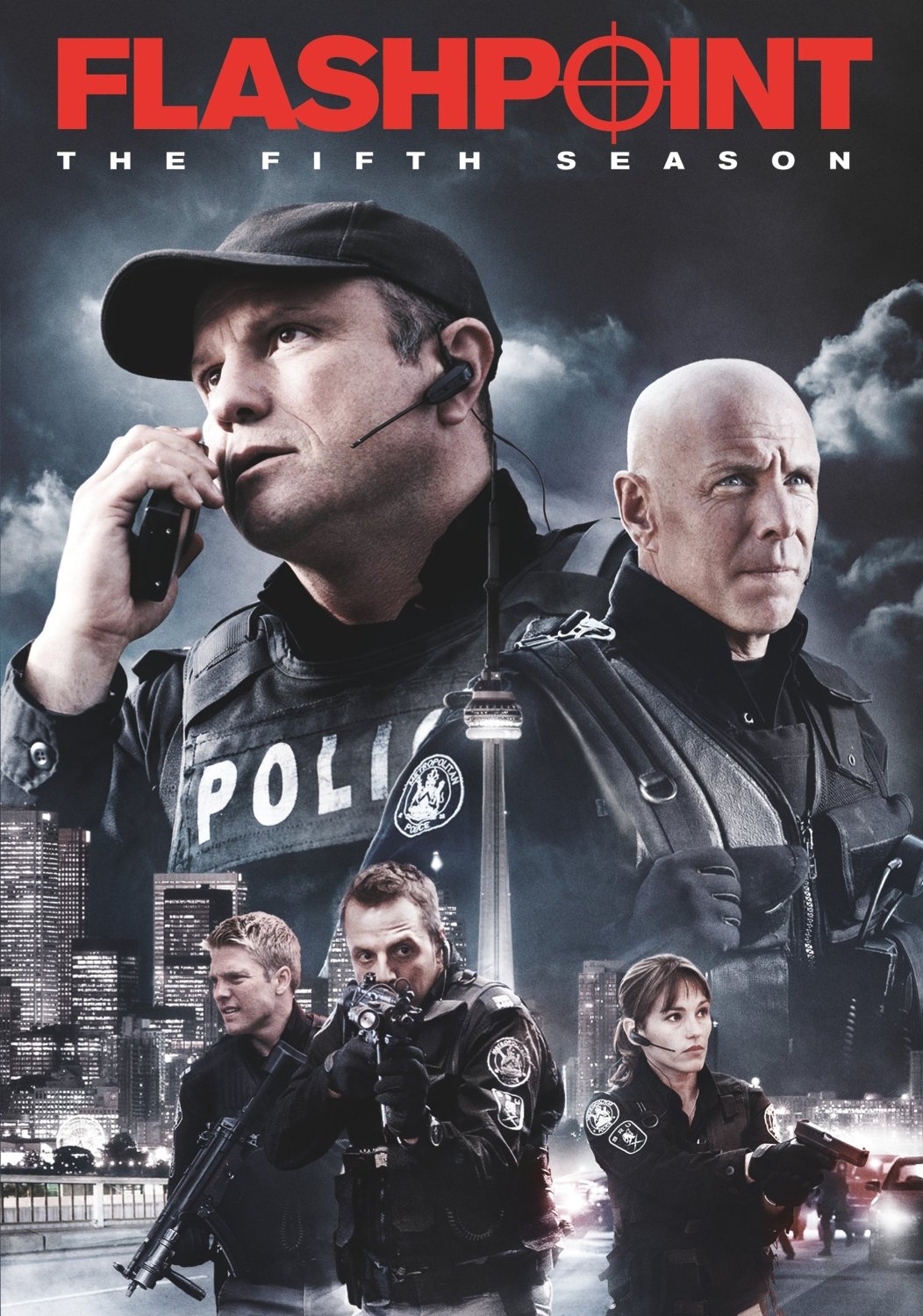
After a four-month hiatus, I have been called to assignment, a very special assignment indeed. Thankfully, the message did not self-destruct after five seconds. However, the message did have demands and required negotiation tactics. That is when I called in the SRU Unit from the show Flashpoint and they burst onto the scene. While they are handling a memo that has a notebook at gunpoint, they left me with a copy of Season Five of Flashpoint to review. Let’s take a look.

Season Five of Flashpoint in U.S. terms are the first eleven episodes under the ION Television banner (though the dvd package is still put out by Paramount/CBS). In Canada, these are the last eleven episodes of season four. The last thirteen episodes of the series will hopefully be in a Season Six package later this year (and Canada will have it as Season Five). Got it? Good.

“This is America’s war as never seen before…”

When you consider the countless documentaries, miniseries and feature films dedicated to the Second World War, you’d think the defining conflict of the 20th century has been covered from every possible angle. And you’d be wrong! History has taken to the skies with WWII From Space, a two-hour special that originally aired on the cable network in December and promised to bring viewers an unprecedented, extraterrestrial perspective of the war.

Before Jay & Silent Bob, Harold & Kumar, and Seth Rogen, James Franco and their current band of merry stoners, there was Cheech & Chong. In terms of pot humor, they were the trailblazers who happily blazed on screen and on stage. The comedy duo’s popularity hit its apex with the release of 1978’s Up in Smoke, which became the year’s highest-grossing comedy. Still, Richard “Cheech” Marin and Tommy Chong’s roots were always in music.

They released nine albums in the ‘70s and ‘80s, winning the Grammy for Best Comedy Album in 1973’s “Los Cochinos.” Some of their most famous songs and routines — including “Dave’s Not Here”, “Earache My Eye”, and “Let’s Make a Dope Deal” — have been re-imagined in Cheech and Chong’s Animated Movie!, the new Blu-ray that was released suspiciously close to April 20. (Unfortunately, this year’s 4/20 didn’t fall on a Tuesday, which is the day most home video titles are released.)

“Now it’s mandatory that you do not make make eye contact until we tell you that it’s all clear.”

Typical, one person can’t follow simple instructions and the rest are doomed to die because of it. Or at least that’s how it starts in Escapee, the new suspense horror film starring Dominic Purcell and Christine Evangelista, or what I like to call it: Halloween with a dash of Friday the 13th. Harsh perhaps, but as I watched the film I could not help but the see the comparisons. It fooled me at first with a fairly interesting opening sequence, but from there, it become painstakingly obvious that the film did nothing but rehash many of the themes that made the previous films famous. It wasn’t until the reveal at the climax of the film that the story felt mildly original.

“Nobody grows up wanting to be a knuckleball pitcher. It’s born of desperation; it’s born of necessity.”

By the start of the 2011 season, there were only two active knuckleballers in Major League Baseball. One was a failed power-hitting 1B/3B, while the other had been cut by his team at the start of the previous year’s spring training. Knuckleball! — an engaging documentary dedicated to the kookiest pitch in baseball history — illustrates how that desperation extends beyond the few brave souls who have attempted to make a living in the big leagues by throwing very softly.

Donnie Yen continues to deliver one great martial arts film after the other, easily making him the most entertaining martial arts star for quite some time.  Sure, there are those who cling to the idea of Bruce Lee being “the best” or perhaps mentioning Jackie Chan or Jet Li for more modern viewers.  But for me it’s Yen, and I have no problem saying he may be the best martial arts star of all time.  His work with Ip Man, Seven Swords, and Flash Point are staples in a career that has been going since 1984.  With Dragon you can check off another hit for Yen; though it may not be as action-packed as some of his previous releases, what we get instead is a fun detective story that asks the question, can a man that has committed atrocious crimes be capable of change?

Dragon opens up in a small village in 1917 China.  The village is quaint; everyone has their place in keeping the village alive and running.  For money the village makes paper; it’s not enough to exactly have everyone living the high life, but that isn’t what you’d expect in this village that probably hasn’t changed much in the past hundred years.  But everything changes when two thieves come into the village and attempt to rob it.  Liu Jin-xi (Yen) reluctantly stops the robbery, and in the process a “fight” breaks out which results in the death of the two thieves.  Was it simply luck on Jin-xi’s part, or is his simpleminded act of heroism a ruse, and beneath it all could he possibly be a trained killer?  This is left to Xu Bai-jiu (Takeshi Kaneshiro Red Cliff and House of Flying Daggers), an investigator sent to the village to decide if it was all an act of self defense.

“I want to talk to you about the war for the soul of Los Angeles.”

This could easily describe the current rivalry between the surging L.A. Clippers and the geriatric Los Angeles Lakers, but Gangster Squad has slightly weightier matters on its mind. The stylish 1940s and 50s cops-and-crooks saga wants to tell a story about corruption and violent men unable — or unwilling — to turn off their capacity for hurting others. Instead, the film winds up being a somewhat shallow 21st century gloss on The Untouchables. And there’s absolutely nothing wrong with that.

“Whose move is it?”

To be honest, I’m not much of a chess player. I know how all the pieces move and I enjoy the mental challenge, but I never really committed to becoming proficient at the game. (Now, if we’re talking Connect Four, you don’t want to run into me in a dark alley.) Pawn establishes its intriguing chess motif early on, before almost completely abandoning it in favor of becoming more of a generically twisty thriller.

“I want to visit a country of dreams, imagination and magic.”

Instead of “dreams, imagination and magic”, the Africa presented in this confounding, family-friendly offering from Spanish filmmaker Jordi Llompart is a place of trippy visuals, head-scratching dialogue and horrid CGI. Magic Journey to Africa — billed as a “giant screen spectacle” — is now available for home consumption, where the film’s dazzling 3D presentation is its only saving grace.