Drama

“I’ve changed a lot. I’m not the same woman.”

Early on in Luis Buñuel’s surrealist gem, a mild-mannered older gentleman named Mathieu douses a beautiful, battered woman with a bucket of water as she desperately attempts to board the train he’s riding. His fellow passengers are stunned, but also understandably intrigued. What possible sequence of events could’ve led Mathieu to this cold and cartoonish gesture? It’s an irresistible hook, and Mathieu proceeds to regale the other travelers — and, by extension, the movie’s audience — with the tale of “the foulest woman who ever lived.”

No matter how much you hated Prometheus — parts of it were startlingly dumb, but people who seriously talk about it like it’s the worst film of all time need to take a deep breath — Ridley Scott has a pretty strong case to be included on any list of Top 10 Living Directors. His work has helped redefine genres (Alien, Blade Runner, Gladiator) given us indelible images (that final still from Thelma & Louise) and even provided a few smaller-scale delights (Matchstick Men is my favorite of this group). So I’m proposing we take a quick break from trashing his last movie to discuss his very first one.

The Duellists follows a pair of officers in Napoleon’s Army during the early part of the 19th century. The film opens in Strasbourg with the mercurial Lt. Feraud (Harvey Keitel) critically injuring the mayor’s nephew during a duel. An even angrier general orders the dutiful Lt. D’Hubert (Keith Carradine) to place Feraud under arrest. Feraud is an avid duelist and thinks he did nothing wrong, so he feels insulted by D’Hubert's accusation. The fact that Feraud is with a woman when D’Hubert arrives to arrest him only adds to his embarrassment. Naturally, Feraud has no choice but to challenge D’Hubert to a duel.

I see an Oscar nominee, an Emmy nominee, an actor who has carried two successful TV shows, and the bad guy from the highest-grossing movie of all time. In other words, I see more talent than you would ordinarily expect from a straight-to-DVD drama. Then again, I also see Soulja Boy, but he’s not the problem. Instead, Officer Down squanders a few fine performances and a solid premise due to some seriously (and unnecessarily) muddled storytelling.

Det. David Callahan (Stephen Dorff) may as well have “Dirty” in front of his name, but it’s not because he tears through bureaucratic red tape in his pursuit of justice; it’s because “Cal” always looks like he desperately needs a shower. Callahan is a former crooked cop/drug addict/philanderer who changed his bad boy ways after narrowly surviving a gun shot wound during a drug bust gone wrong. Cal never knew the identity of the man who saved his life until the Good Samaritan comes forward one year later.

When I first received Love Me, I thought it was going to be just another angsty teen drama. (Something along the lines of Dawson’s Creek.) That notion was quickly disabused, however, when a young girl is stalked and attacked in the opening scene. From there, the film jumps ahead three months, with the town still reeling from her disappearance. While discussing how eerie the case is with her friends, Sylvia Potter (Lindsay Shaw, TV’s Pretty Little Liars) quite literally bumps into rich pretty boy Lucas Green (Jamie Johnston, TV’s Degrassi: The Next Generation) and falls for him instantly.


Fortunately for Sylvia, the feeling is mutual and, despite her friend’s many protests, Sylvia begins dating Lucas. As their relationship deepens, Sylvia discovers some unsettling things about Lucas, including the fact that he was dating the missing girl at the time of her disappearance and police consider him the prime suspect. As the pressure mounts and new evidence comes to light, Sylvia must decide what — and, more importantly, who — she believes.

If Compliance weren’t based on true events, the film’s plot would immediately be dismissed as implausible and insulting of its audience’s intelligence. (Same with Argo.) As the story of an incredibly committed prank caller and his unwitting prey progresses, there’s a pretty good chance you’ll repeatedly roll your eyes. There’s an even better chance the eye rolling will be followed by a feeling of outrage — definitely toward the caller, but maybe even toward the gullible victims — when you remember this stuff actually happened.

Sandra (Ann Dowd) is a stressed-out manager at ChickWich, a fictional fast food restaurant. During a busy Friday shift, she receives a call from a man identifying himself as “Officer Daniels” (Pat Healy), who claims one of Sandra’s employees stole money from a customer. Officer Daniels convinces Sandra to interrogate teenage cashier Becky (Dreama Walker) in the restaurant’s back room. What follows is a slow and steady stream of humiliations for Becky as Sandra instructs her employees — and eventually her fiancé, Van (Bill Camp) — to follow the officer’s increasingly bizarre instructions.

TNT prides itself on “knowing drama,” but as far as I’m concerned the network’s best series was also its most woefully underappreciated. It didn’t have any cops, lawyers or doctors. It wasn’t as light or slick as some of the channel’s hits like The Closer (cops), Franklin & Bash (lawyers) and Rizzoli & Isles (a cop AND a doctor; don’t make me guess which is which). It didn’t have aliens (Falling Skies) or impossibly charismatic crooks (Leverage). Instead, Men of a Certain Age dealt with a topic that is much less fun to think about, yet happens to 100 percent of us: getting older.

I realize a show that deals honestly with aging sounds about as much fun as a colonoscopy. (Coincidentally, the Men embark on a weekend colonoscopy outing in Ep. 6/ “Let the Sunshine In.”) Men of a Certain Age simultaneously celebrates life’s small victories while chronicling its many indignities. Thankfully, the show’s excellent acting, writing and directing keep the material entertaining and genuine.

Do you realize how much you’re affected by advertising? Branded attempts to answer this question while showing us where our world is headed if the trend continues. Mishka Galkin (Ed Stoppard, The Pianist) is Russia’s advertising whiz kid. When Mishka meets Abby (Leelee Sobieski, 88 Minutes, The Wicker Man), they immediately become friends, despite the fact that she is the niece of Bob Gibbons (Jeffrey Tambor, TVs Arrested Development, the Hellboy movies), Mishka’s boss. Even though Bob warns him to stay away from Abby, Mishka enters into a personal and professional relationship with her, developing an Extreme Makeover-type show in Russia together. Unfortunately, the show tanks when the woman getting the makeover falls into a coma following her cosmetic surgery.

In the public outcry that follows, Mishka is jailed and Abby is deported. When he gets out after being incarcerated for a few days, Mishka angrily confronts his boss, claiming that Bob used his former CIA contacts to orchestrate the show’s failure so that Abby would leave Russia (and Mishka). During this argument, Bob has a heart attack and dies. Believing his marketing ability is “a curse” harming those around him, Mishka decides to leave the advertising business behind and become a hermit. (The idea that Mishka’s ability is a curse comes from the film’s narrator, who sounds like GLaDOS, the evil computer from Portal.)

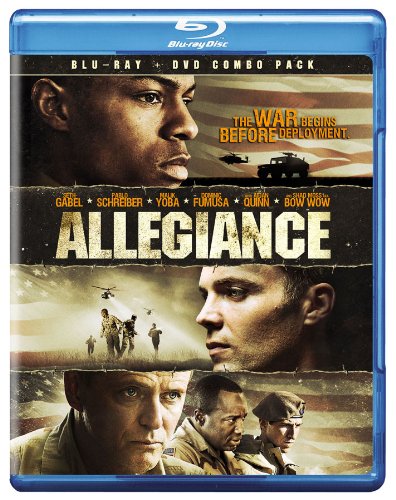
What do you do when you have to choose between the law and what is morally right? Lieutenant Danny Sefton (Seth Gabel, TV’s Dirty Sexy Money and Fringe) faces that very problem in Allegiance. Having lost the respect of the men in his command by transferring to a recruiting position right before they are to deploy to Iraq, Sefton faces a crisis of conscience when one of those men — Specialist Chris Reyes (Shad “Bow Wow” Moss, Like Mike, Roll Bounce) — has his non-deployment waiver revoked.

Reyes’ son is sick. However, due to conflicting diagnoses — one says Stage 4 lung cancer; the other chronic asthma — and the fact that he’s the best medic in the company (and they don’t have a replacement), Lieutenant Colonel Owens (Aidan Quinn, Jonah Hex, TV’s Elementary) decides to deploy Reyes. Having exhausted all his options, Reyes tells Sefton he intends to go AWOL and asks for Sefton’s help.

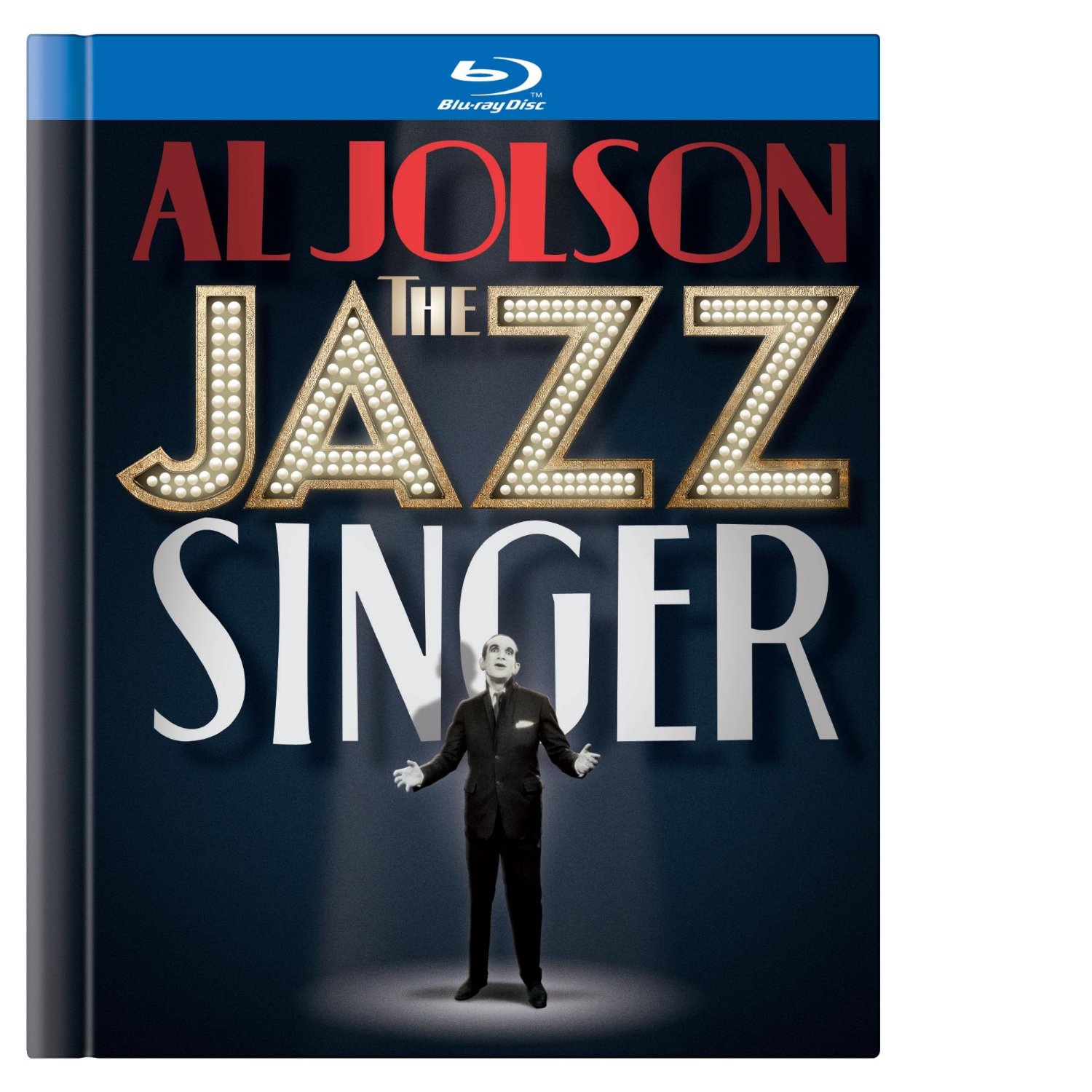
If you’re any sort of discerning cinephile — and if you’ve taken the time to visit our fine site, I’m going to assume you are — you’ve probably heard of The Jazz Singer. Of course, for the movie-going public in the late 1920s, The Jazz Singer was unlike anything they’d ever heard: the first feature-length motion picture with synchronized dialogue. Or, put more simply, the first “talkie.” Though you probably know it revolutionized the film industry, I’m betting it’s a lot less likely you’ve actually seen The Jazz Singer.

I liken it to Jackie Robinson’s place in sports history. Most of us know Robinson was the first African-American Major League baseball player in the modern era, but I suspect a much smaller number of us have seen footage of Robinson in action. Similarly, The Jazz Singer’s place in film history has been secure for decades, but even movie nerds with more than 700 titles in their collections (hi there) haven’t gotten around to watching it. Fortunately, Warner Bros. has released a spiffy new Blu-ray of the groundbreaking 1927 film to help remedy this situation.

When it comes to writer/director Spike Lee, he seems to have a very polarizing effect on the people who watch his films.  I’d like to consider myself a fan of most of his work.  For me  Clockers, Summer of Sam, and The 25 Hour rank at the top of my list of favorites.  He’s a director with a very distinct style and voice that sets him apart from most filmmakers.  But it’s that voice of his that often times gets him in trouble, whether it is in the message of his films or oftentimes comments he makes (most notably his comments on Tarantino and Django Unchained). As for Red Hook Summer, I wasn’t sure what to think of it, hearing mixed reviews from the festival circuit.  For me when I heard this was supposed to be a unofficial follow-up to Do The Right Thing, I was already looking forward to checking this out.

When we first meet Flik Royale (newcomer Jules Brown) he’s in the back of the cab coming into Brooklyn for the first time with his face hidden behind his iPad 2 as he films everything.  Flik comes from a middle class family in Atlanta, so of course this move to spend the summer with his religious grandfather is more than just a simple culture shock.  At first it’s hard to sympathize with Flik simply because he comes off as nothing more than a spoiled brat, but as the film moves along I found myself warming up to him more and more.